
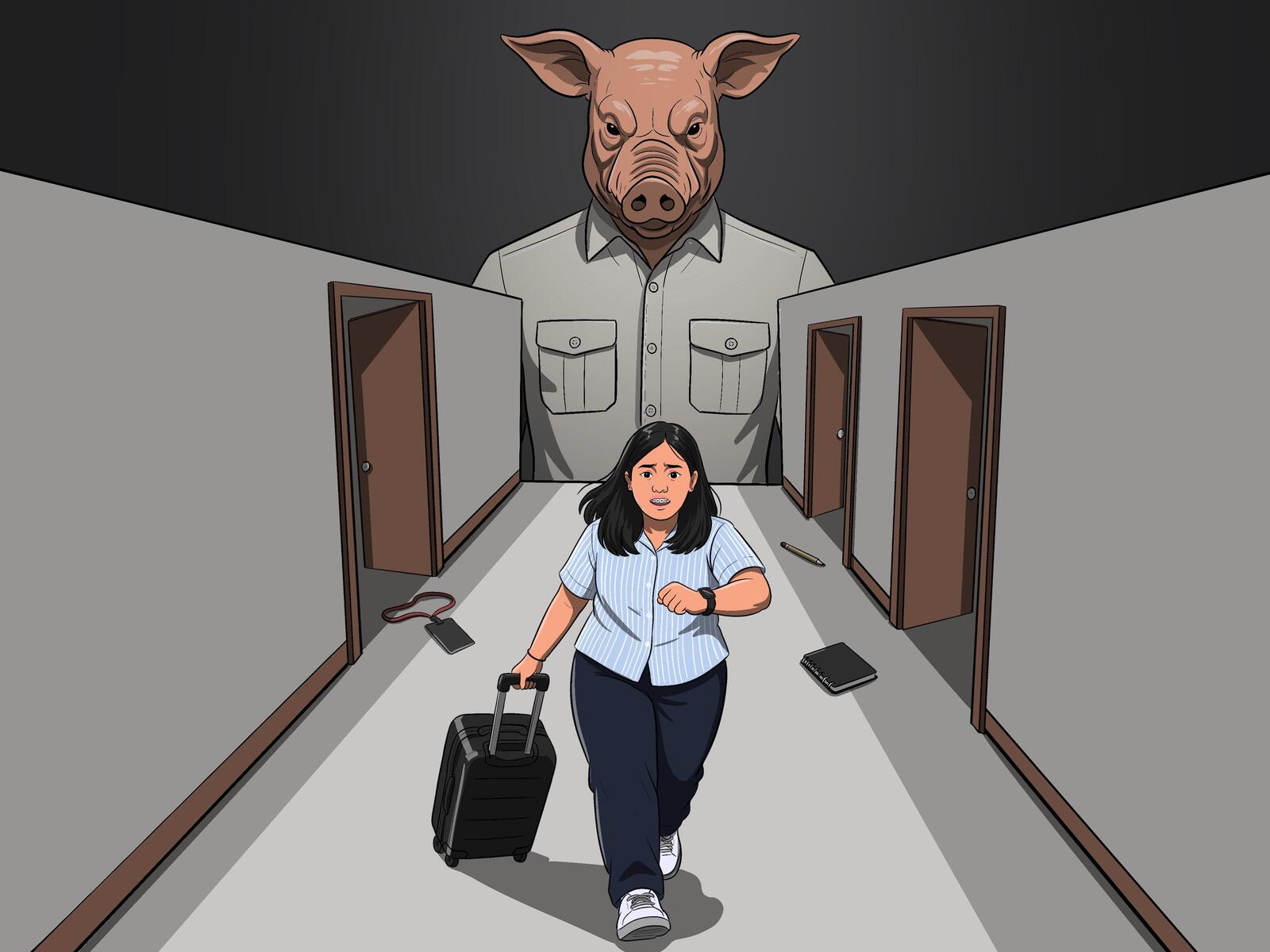
For the Indonesian media, there’s one key difference between the Jokowi and Prabowo administrations: the former monitored newsrooms from the outside, whereas the latter has people watching from within.
THERE was a period in April 2025 when Cica had to become someone else.
She stayed in three different places, cut herself off from the outside world, and used an alias. She was no longer Francisca Christy Rosana, a political reporter for Tempo, one of Indonesia’s most prominent investigative news outlets. For the time being, Cica simply didn’t exist.
It all started with a pig’s head.
Sent to Cica by an unknown party, the package arrived at Tempo’s South Jakarta office on March 19 — although Cica didn’t receive it until she went to the office the following afternoon.
Hussein Abri Dongoran, a fellow political reporter, helped her open it.
When they pried open the cardboard box, a rotten smell hit them immediately, although the cause of stench was still hidden beneath a layer of styrofoam. Hussein kept digging until he saw it.
“It still had blood on it,” Hussein said.
Cica slumped into her chair and cried.
She thought of the wife of human rights activist Munir Said Thalib, who was sent a chicken head two months after her husband was murdered in September 2004.
“My first thought was my parents’ safety,” Cica said. “What if they would also be targeted?”
“The way I saw it, when someone sends you a head, they’re either threatening to kill you or your family.”
The package didn’t contain any written message and no one could clearly identify what had motivated the person sending it. After all, Tempo’s reporting is often a source of irritation for those in power.
However, at the time it was sent Cica and her colleagues were covering a controversial legislative revision that would expand the military’s authority and allow serving officers to occupy a wider range of civilian posts.
Friends and supervisors tried to calm Cica down. Several senior editors told her the same thing: “If you let yourself get scared, then those trying to terrorise you have won.. We need to show whoever did this that you’re not afraid.”
So Cica quickly posted a tweet on her X account, keeping the tone light:
“Next time, don’t send a pig’s head. Send some nice cuts of pork instead,” she wrote.
Cica went ahead with a scheduled podcast recording that day to discuss the legislative revision she’d been covering.
That same day, parliament passed the revised military law amid a torrent of opposition from those alarmed that the military would reclaim the position it held during the authoritarian New Order regime, when it was deeply enmeshed in governance through military-only parliamentary seats and important public service roles.
That night, after they wrapped up the podcast recording, Cica’s exit from her normal life began.
Accompanied by her friends, she went to her boarding house room to pack her clothes. Then the group headed to Tempo’s office, which for the next two weeks became Cica’s safe house. A group of colleagues – at least seven at any one time – took turns keeping her company.
“We decided I’d just stay at the office, because the safest place is on ‘the battlefield’, plus it has security guards,” Cica said.
In her first days sheltering at the office, Cica finished writing her story on the military law revision, which later ran as the cover story for the March 23 edition of Tempo Magazine.
However, she found it hard to concentrate on her work. What’s more,the harassment didn’t end with the pig’s head.
The same night Cica took refuge at the office, an unknown party took control of her mother’s phone number and used it to contact and threaten her sister and niece.
That same day, Tempo’s website was hit with a distributed denial-of-service (DDoS) cyberattack, in which servers, sites, or networks are knocked offline via a deluge of fake traffic.
The following day, March 21, an Instagram account called @derrynoah sent a string of threatening messages to Tempo, vowing to keep terrorising them “until your office is shut down”. The account also doxxed Cica, posting a screenshot of her photo and full name.
In the early hours of March 22, someone threw a box containing six dead rats into the Tempo office complex. Cica was still working on her story. To keep her focused, colleagues didn’t tell her about it until she had finished writing.
After the March 23 edition of Tempo Magazine hit the newsstands, the physical intimidation started to die down, but the DDoS attacks continued.
After two weeks at the office, Tempo moved Cica into an apartment. She brought no identification, no smartphone and no laptop, cutting herself off from the internet entirely.
She only interacted with two colleagues, who stayed with her and referred to her by an alias. When communicating with her parents, Cica passed messages through her supervisor.
As far as Cica can remember, she spent about 10 days in the apartment. But her memories of those days are hazy.
She only remembers the deep stress – a time that left a lasting trauma.
She didn’t work. She didn’t know what was happening outside. She didn’t know what to do with herself. She spent her days lost in her own thoughts.
“A lot of my memories from those days in the apartment are gone.”
“What I do remember is constantly asking myself, why do I have to go through this?”
“Why do I have to feel unsafe when all I did was my job?”
“Did I do something wrong?”
“What did I do wrong?”
Bracing for Prabowo
The attacks against Tempo were both shocking and entirely predictable.
After all, the man now occupying the presidential palace is Prabowo Subianto, a former son-in-law of Suharto, the dictator who presided over the country’s New Order regime from 1966 to 1998.
Prabowo had been angling for the nation’s top job since 2004, when he sought nomination as the presidential candidate for Golkar, Soeharto’s political party. He ran as a vice-presidential candidate in 2009, then as a presidential candidate in 2014, and again in 2019. Every attempt ended in defeat.
He finally won in 2024, at the age of 72, after pairing up with Gibran Rakabuming Raka, the eldest son of former president Joko Widodo.
Across that string of losses spanning more than 20 years, the Indonesian press has become familiar with his temperament.
After the 2014 presidential election, Prabowo lashed out at a Metro TV reporter who was scheduled to interview him.
“Metro TV is evil. What have I ever done to Surya Paloh for you people to be so cruel to me?” Prabowo said, referring to the owner of Metro TV, who is also chairman of another Indonesian political party.
On another occasion in 2014, Prabowo unloaded on a reporter from The Jakarta Post, saying, “It’s not your fault, but your newspaper is a disgrace!”
The bottom line is that Prabowo does not appreciate difficult questions or unflattering coverage, not to mention any reference to the dark chapters of his past. That includes his role in massacres in Timor Leste from 1975 to 1999, as well as the kidnapping and forced disappearance of pro-democracy activists in 1997 and 1998.
So after the General Elections Commission officially declared Prabowo the winner of the 2024 presidential election, the media braced for a new dark chapter to begin.
At Tempo, chief executive Arif Zulkifli, known as Azul, gathered the reporters and editors to discuss the challenges they might face under the Prabowo administration.
Azul told them that, across every era, those in power had always regarded Tempo as the enemy, even though the publication had only ever challenged authority in the way journalism should in a free society. But Tempo had weathered the tough times and survived to the present day.
“Azul said that, while we could be afraid of the current regime, that fear must never make us submit. We know many media outlets will likely submit going forward due to business difficulties and so on, but Tempo remains Tempo. No matter who’s in power, we will not submit,” Cica said, recounting Azul’s message.
“Basically, we were given strength and told how we needed to carry ourselves.”
Cica recalled raising a question: what should reporters do if sources went to ground under the Prabowo era?
“If we can’t get in through the door, there’s still the window, still the ventilation shafts,” Azul replied.
“In every regime, there are always people on the inside who feel uneasy about what’s happening. Our job is to find and map out those people.”
Similar conversations took place at other media organizations, though they didn’t always happen in large, formal meetings involving the entire newsroom.
At one digital news portal under a major national media group, for example, editorial guidance on Prabowo’s coverage was not communicated openly in official meetings. Instead, it trickled down verbally from the editor-in-chief to the section editors, and then to the reporters.
Such directives began circulating during the presidential campaign period, from 28 November 2023 to 10 February 2024.
“We already knew that [Prabowo] doesn’t like us, and that his relationship with the media has never been good,” a source at the outlet said, describing the guidance from the editor-in-chief.
“So we had to figure out how to stop him getting even angrier at us.”
The editorial team was told to be extra cautious. When choosing sources, reporters had to understand the political landscape. For instance, they were not to use commentary from analysts who were affiliated with or showed favoritism toward a particular political camp.
After Prabowo won the election, the calls for caution grew louder. For this particular news portal, revenue from advertising and government partnerships was significant. One wrong move that stirred Prabowo’s anger and the company’s finances (and the livelihoods of many employees) could be on the line.
“The idea was to manage the government’s mood,” the source said.
“Because we still depend on them, on whoever’s in power.”
A formal meeting took place at another media conglomerate. The top boss gathered editors-in-chief and managing editors from the group’s various outlets to discuss editorial policy under the Prabowo regime.
They discussed the “instability” that had emerged following the Prabowo-Gibran victory in the 2024 election.
Gibran was able to run as Prabowo’s running mate after the Constitutional Court changed the eligibility requirements for presidential and vice-presidential candidates. Previously, candidates had to be at least 40 years old. The court carved out an exception that allowed candidates under 40 to run, provided they had held or were currently holding an elected political position, such as mayor of a regional city.
On Oct. 16, 2023, a Constitutional Court panel led by Anwar Usman, Gibran’s uncle, read out the ruling, just three days before registration opened for presidential and vice-presidential candidates for the 2024 election. That opened the door for Gibran, who was only 36 at the time and serving as mayor of Surakarta in Central Java.
The decision caused an uproar. Many observers called it a setback for democracy, a textbook case of dynastic politics. The controversy hurt Indonesia’s image in many quarters, including among foreign investors. This was the “instability” referred to in the internal discussion among media conglomerates.
“If that instability persisted, it could spill over into the economy,” a source within the media group said, explaining the company’s outlook at that time.
To keep things from spiraling further and to protect economic sentiment, the boss decided that, for the time being, the group’s outlets would support the government while waiting for the new administration’s direction to become clearer.
The boss told the outlets not to level excessive criticism at government programs. If they had to criticize, the tone should be more “measured”. The stance would be revisited as the administration’s track record took shape.
“Support the government first, keep things steady, and see where things are heading. The important thing is that the economy doesn’t tank,” the source said, explaining the boss’s directive.
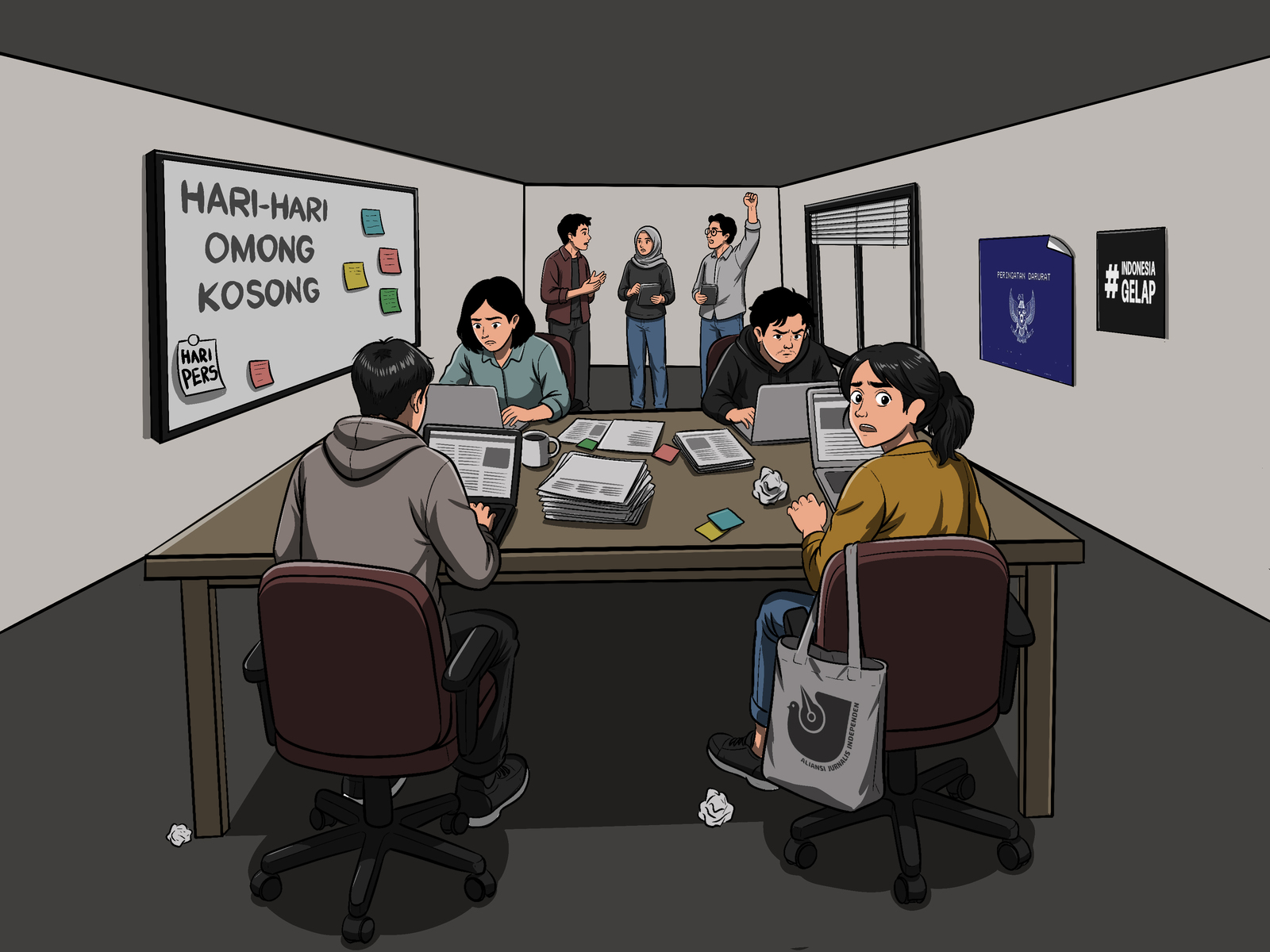
Beyond the corporate level, Prabowo’s election victory also had a chilling effect on individual journalists. Many sought collective protection, including by joining professional organizations like the Alliance of Independent Journalists (AJI).
As of April 2026, AJI had nearly 2,000 members spread across Indonesia. AJI Jakarta was the largest chapter, with 379 members.
Irsyan Hasyim, chairman of AJI Jakarta, said the organization typically opens membership applications once a year. Before Prabowo won the presidential election, a single enrollment period attracted at most 40 applicants, and AJI typically accepted about half of them.
But when AJI Jakarta opened registration in September 2024, about a month before Prabowo’s inauguration, the number of applicants surged to 95. Only 44 made the cut.
AJI Jakarta re-opened enrollment in July 2025. More than 60 journalists applied, but AJI admitted only about 30.
Irsyan said a large number of journalists from a publication whose staff don’t typically join AJI suddenly applied during those two enrollment periods. A senior editor at another outlet, who had never been a member, applied for the first time.
The fear of a repressive government had driven journalists to band together.
This newfound desire to organise, Irsyan said, was a clear “response to the regime”.
A Year Full of Violence
It didn’t take long for the journalists’ fears to become reality.
Throughout 2025, AJI documented 89 cases of violence against journalists and media organizations, up from 73 cases in 2024.
Physical violence topped the list at 30 cases, followed by 29 digital attacks (the highest in 12 years) and 22 cases of terror and intimidation.
On top of that, AJI recorded bans on certain types of reporting, destruction of equipment, deletion of journalistic data, and Strategic Lawsuits Against Public Participation (SLAPPs) targeting press organizations.
Police were the perpetrators in 21 cases, and the military in another six. The largest group of perpetrators, however, were the unidentified, accounting for 29 cases tied mostly to digital attacks and acts of terror.
“This indicates that attackers have grown increasingly skilled at hiding behind anonymity,” AJI wrote in its 2025 annual report.
Findings from the Legal Aid Institute for the Press (LBH Pers) painted a similar picture. Over the course of 2025, LBH Pers recorded 96 attacks on the press, the highest figure in a decade. The attacks affected 149 victims, including individuals, organizations, and media companies.
Of those cases, 23 allegedly involved police, 13 involved public officials or their aides, and four involved members of the military.
“The vast majority of cases never received a meaningful law enforcement response, reinforcing a culture of impunity and leaving deep trauma across the journalism community,” the LBH press wrote.
The findings from AJI and LBH Pers aligned with the 2025 Journalist Safety Index (IKJ) report produced by the Tifa Foundation in partnership with Populix.
In 2025, the IKJ score fell to 59.5, down 0.9 points from the previous year, signaling a nationwide decline in journalist safety.
Of the 655 respondents surveyed, 67% reported experiencing abuse, with a combined total of 775 incidents. The most common forms of abuse were bans on news coverage and bans on reporting in the field.
According to the study, censorship had become deeply embedded in newsrooms. Around 72% of respondents said they had experienced it, and alarmingly the restrictions often came from within media institutions themselves. Newsroom editors were the primary agents of censorship at 41%, followed by media owners at 18% and management at 10%.
Eighty percent of respondents admitted to self-censoring. A controversial government program aiming to provide free, nutritious meals to school children (Makan Bergizi Gratis, or MBG) topped the list of ‘sensitive’ topics that drove journalists to self-censor. The list also included Nationally Strategic Projects (PSN), especially large-scale infrastructure like toll roads and dams.
“On the MBG issue, several media organizations said they received informal messages telling them not to write stories with ‘negative vibes.’ These directives came with no official explanation of their source or rationale,” the Tifa Foundation wrote in its IKJ 2025 report.
“That lack of clarity drives media organizations and journalists to self-censor as a preemptive measure against potential risk.”
Navigating the Barrage of Intimidation
The data compiled by AJI, LBH Pers and the Tifa Foundation gives some sense of the scale of what the press is facing under Prabowo Subianto’s administration, but it barely scratches the surface.
To understand how pressure functions behind the scenes, Project Multatuli spoke with 70 current and former employees of 37 different press organizations between late December 2025 and April 2026.
The vast majority of these sources would not agree to go on the record with their real names. Of the six who would, three were from Tempo. The remaining 64 would only share information if we concealed their identities and avoided mentioning any details that could identify them or their employers.
Those conversations allowed us to piece together a picture of the daily forms of pressure journalists face.
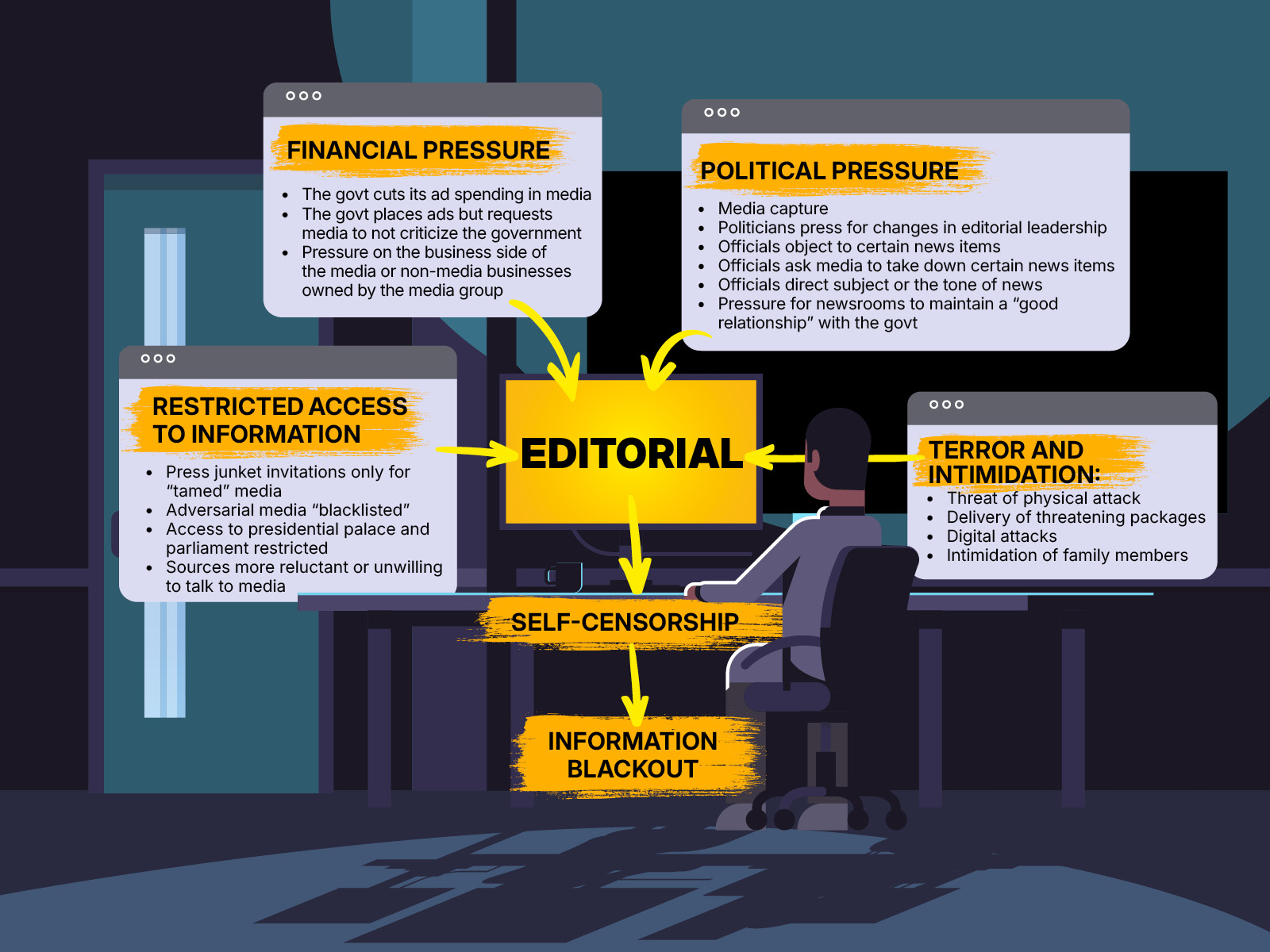
Many reporters described an increasingly restricted information environment. Invitations to events went only to outlets considered friendly to the government. Sources, broadly speaking, had become tighter-lipped and more reluctant to criticize the regime. When they did agree to talk, it was almost always on the condition of anonymity.
Some government officials routinely contacted senior editors and media company owners to complain about coverage, demand stories be taken down, and even threaten the viability of their businesses.
Applying pressure through advertising was another tactic. Since the Prabowo administration tightened budgets across ministries and agencies, government spending on ads in the media had dropped sharply. Various ministries and agencies were still willing to place ads or partner with media outlets, but only if the media played nice and avoided publishing stories that challenged the regime’s programs.
More recently, a politician in Prabowo’s inner circle had been aggressively maneuvering to “annex” several major media outlets, placing loyalists inside them to control the editorial agenda.
With all of that pressure bearing down on the media, it’s no surprise that self-censorship has become widespread. To borrow a phrase from the Tifa Foundation’s IKJ 2025 report, a “dark room” has emerged in public discourse.
Economic and political interests now dictate the flow of information. The public struggles to access comprehensive and trustworthy reporting because gatekeepers have filtered much of it out long before it gets close to publication.
Media organizations have become more like agencies, writing stories tailored to their clients’ wishes. Morale among journalists had cratered. Many want to push back but fear getting fired or putting their employer out of business. One wrong word and everyone’s livelihood is at stake.
One journalist said the difference between the current administration and its predecessor was that, under Jokowi, regime loyalists watched the newsroom “from the outside”.
“The problem now is that they’ve come inside. They’re right there, sitting in front of us.”
The #DeadPressSociety series seeks to expose the many forms of press suppression taking place under the administration of Indonesian President Prabowo Subianto. This is the first article.