

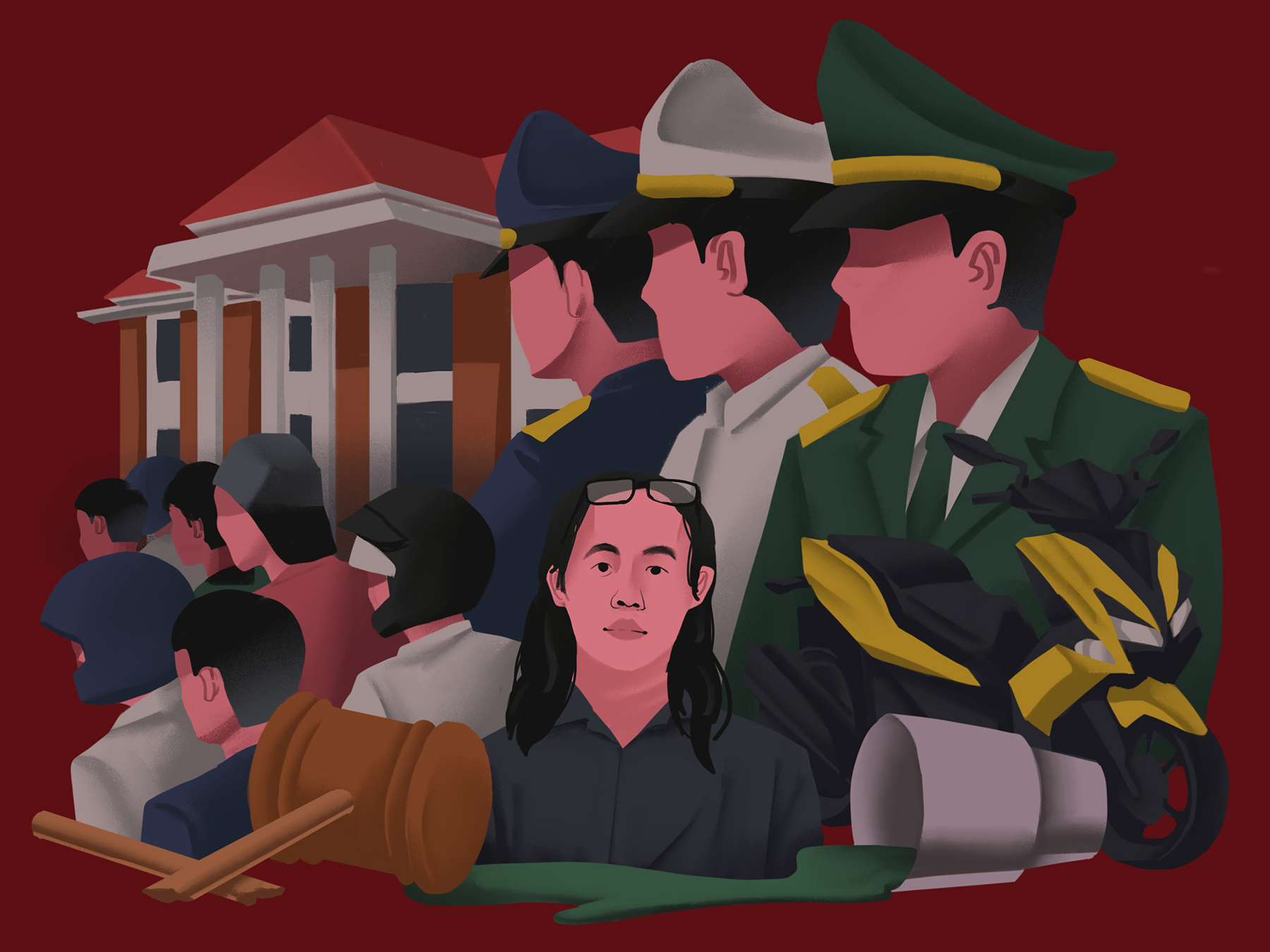
Four soldiers have been convicted over the acid attack on human rights activist Andrie Yunus. But Project Multatuli’s investigation found signs of a wider intelligence operation, with more suspects, stolen civilian identities, and a military trial that left key questions unanswered.
On the evening of March 12, 2026, human rights activist Andrie Yunus was riding through Central Jakarta when two men on a motorcycle pulled close and hurled acid at him.
Andrie, a deputy coordinator with the Commission for Missing Persons and Victims of Violence (KontraS), dropped his motorcycle and removed his helmet as he cried out in pain. The corrosive liquid burned more than 20 percent of his body, including his face, neck, chest, back, and both arms. It also severely damaged his right eye.
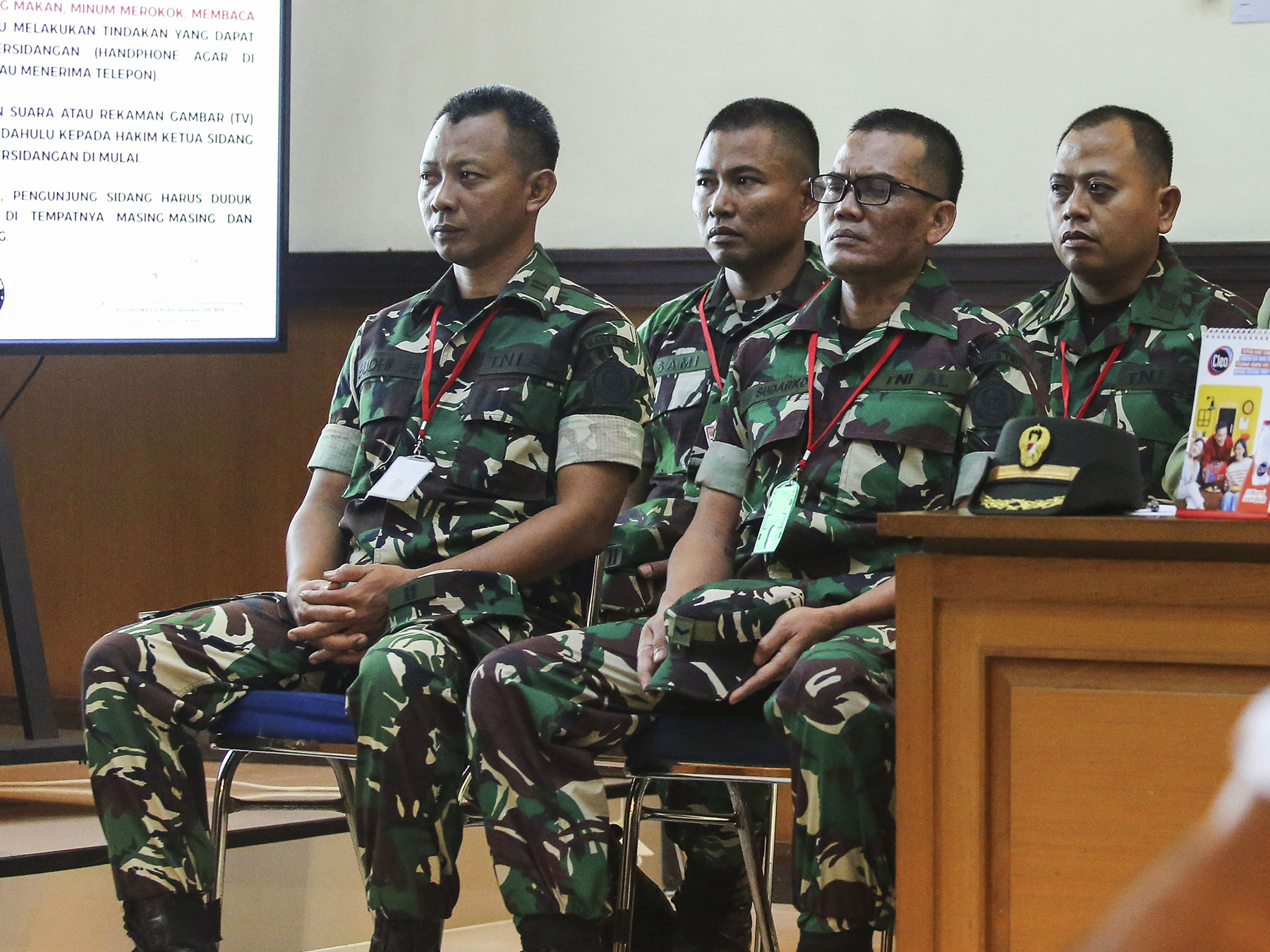
On June 10, a military court in Jakarta sentenced four soldiers, identified by the Indonesian Military (TNI) as the perpetrators of the acid attack, to between 18 months and three years in prison.
According to the military, three of the four were Navy personnel: First Lieutenant Budhi Hariyanto Widhi Cahyono, Second Sergeant Edi Sudarko, and Captain Nandala Dwi Prasetya. The fourth, First Lieutenant Sami Lakka, was an Air Force officer. All were serving in TNI’s Strategic Intelligence Agency (BAIS).
Before the military judges, they claimed that the assault was spontaneous, driven by a personal grudge and carried out without advance planning or orders from their superiors.
Project Multatuli’s two-month investigation, however, points to a very different story.
Beyond the four perpetrators presented by the military, we have identified six other active TNI personnel suspected of involvement in the acid attack.
A civilian with IT expertise who resided at an official BAIS property in South Jakarta is also suspected of remotely coordinating communications for the operation.
The operation appears to have relied on a network of mobile numbers activated only days before the attack. Some were registered under identities stolen from a housewife, an ailing elderly person, and even a five-year-old child.
The findings are consistent with those of the Advocacy Team for Democracy (TAUD), which has repeatedly stated that the attack involved more than four perpetrators. Since March, TAUD has mapped at least 16 individuals suspected of playing roles in the assault.
Among the names uncovered by our investigation is an Army major identified by the initials RD. Higher in rank than any of the four men prosecuted by the military, RD was designated by TAUD as Suspect No. 12.
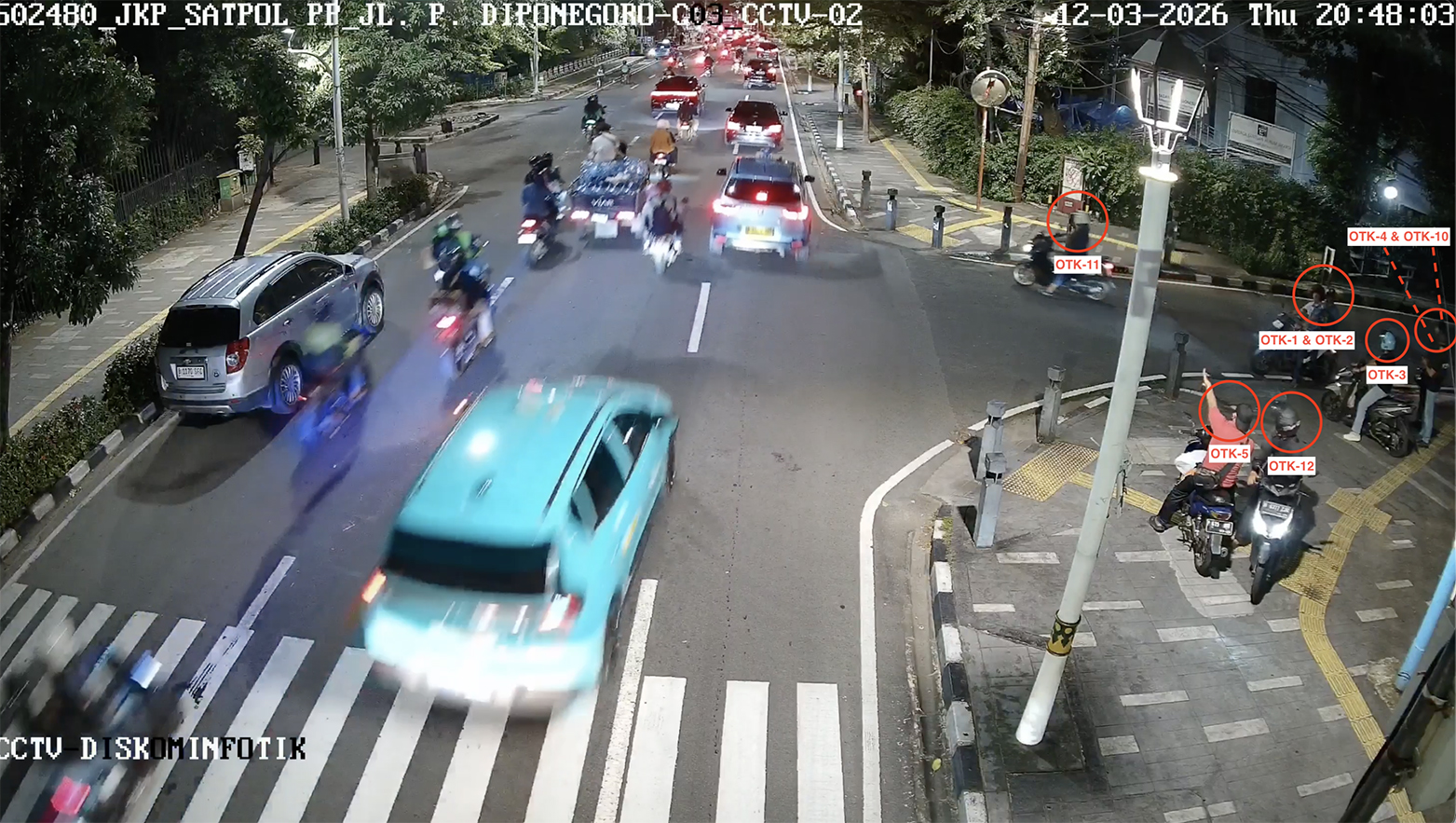
CCTV footage obtained by TAUD shows RD in contact with at least eight other suspects in the hours before the attack. TAUD believes he coordinated the operation.
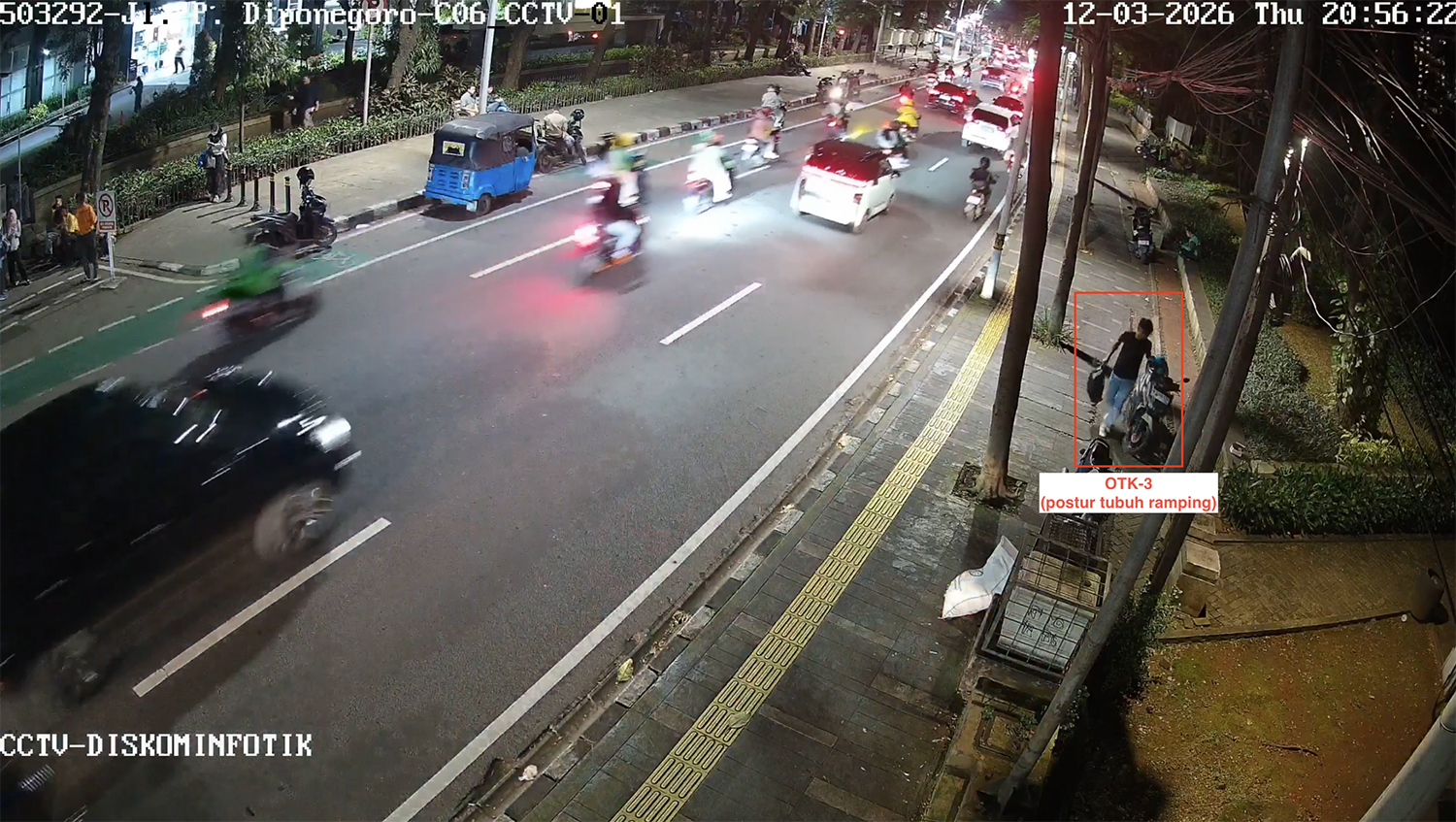
On the evening of the attack, RD was seen near the office of the Indonesian Legal Aid Foundation (YLBHI) on Diponegoro Street, where Andrie had recorded a podcast episode on the military’s expanding role and stayed until about 11 p.m.
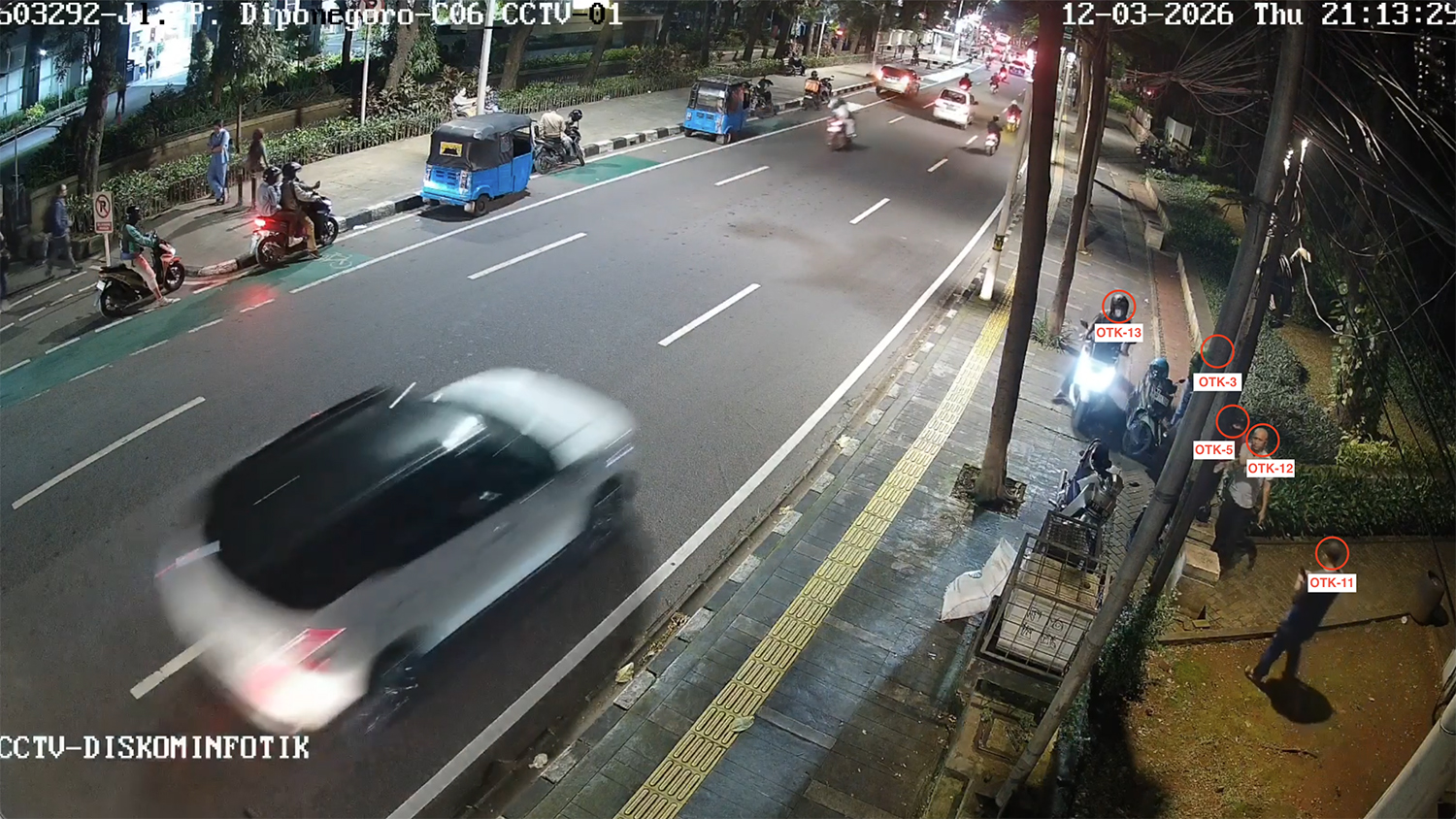
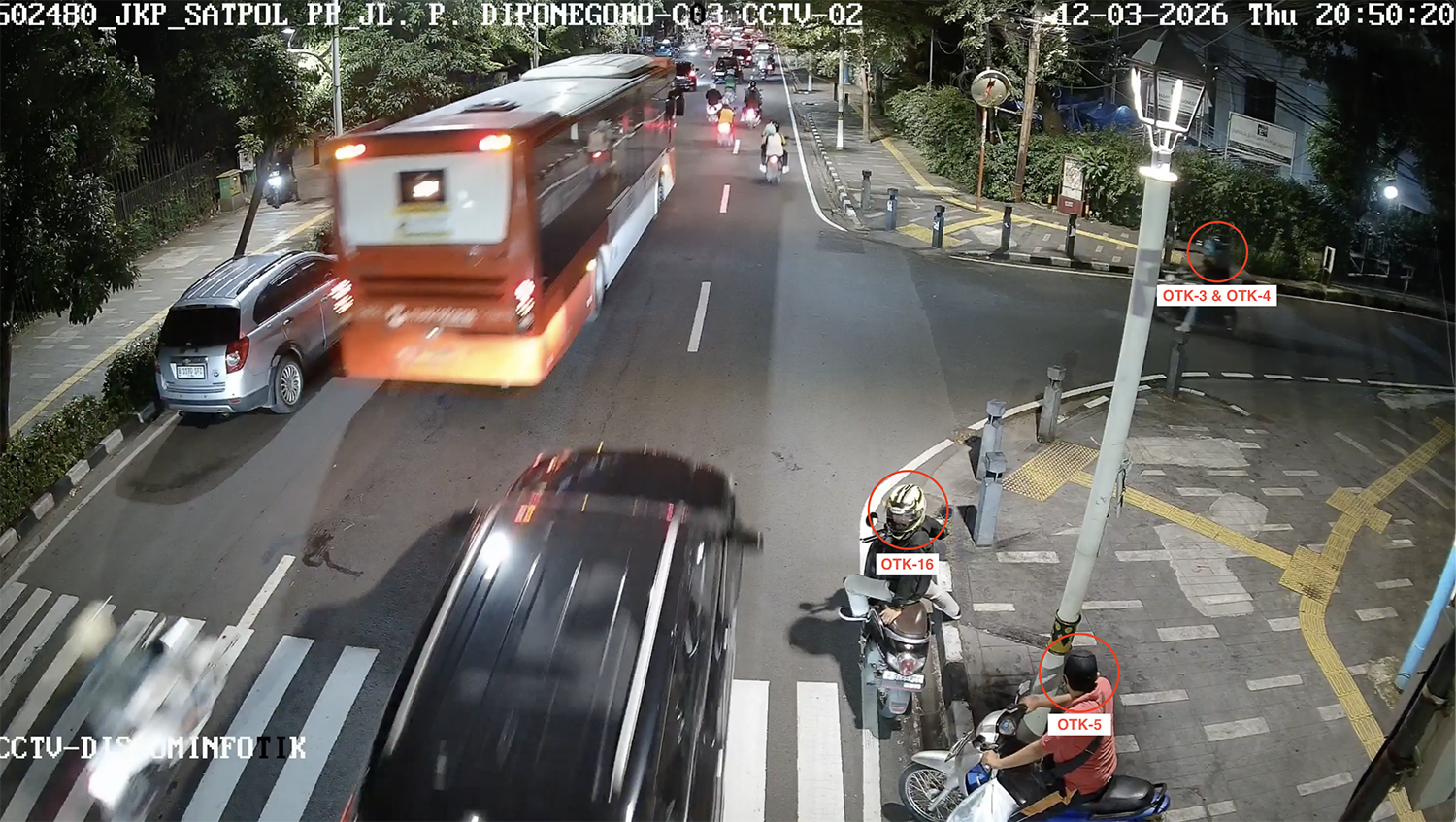
At 8:48 p.m., RD was seen on a motorcycle, wearing a helmet and face mask as he spoke with Suspect No. 5 on the pavement across from the YLBHI office. At 9:13 p.m., he was seen again at nearby Diponegoro Park, this time without the helmet and mask.
RD was using a black Honda Vario with license plate B 6**7 ZJR, which was registered in his wife’s name. When Project Multatuli visited his neighborhood in Depok, West Java, a resident confirmed that RD served in BAIS, the military intelligence agency.
“Yes, D***. He’s with BAIS,” the resident said, referring to RD by his nickname.
In addition to RD, Project Multatuli identified another Army officer known by the initials SS.
According to a police analysis report obtained by Project Multatuli, a phone number registered to SS (+62 877-2646-6XXX) was detected at several key locations: near the YLBHI and KontraS offices, the Bright Cikini petrol station where Andrie had stopped shortly before the assault, and Salemba 1 Street where the assault took place.
Project Multatuli verified that the number was linked to a WhatsApp account with a profile picture showing SS in an Army uniform. Two jasmine insignia on his shoulder boards indicated the rank of lieutenant colonel.
Tracing the Suspects
A phone number linked to Budhi Hariyanto Widhi Cahyono sat at the center of the operation’s communications network.
During the military trial, Budhi was identified as the motorcyclist carrying the man who threw acid at Andrie Yunus on March 12, 2026.
As shown in a police analysis report obtained by Project Multatuli, Budhi’s number was connected to at least five other phone numbers detected around the Indonesian Legal Aid Foundation (YLBHI) office that night. All five had been activated just one or two days before the assault.
Budhi was found to have sent Rp22,000 (US$1.2) in prepaid mobile credit to each of two Telkomsel numbers: +62 821-1705-XXX and +62 821-1685-XXX. Both were registered under the name of a five-year-old boy, the son of an active Navy officer identified by the initial A.
Budhi also communicated with the numbers +62 813-9XXX-661, +62 813-9XXX-659, and +62 813-16XXX-504. All three appear to have been registered using the identities of civilians with no apparent connection to the case, including a housewife in Serang and an elderly casual laborer in Lebak, both in Banten province.
At around 4:41 p.m., the number registered under the elderly man’s identity contacted another number: +62 813-3460-72XXX. That number was registered to a Navy officer identified by the initials OAW.
On the night of the attack, OAW’s phone was detected near Dr. Cipto Mangunkusumo Hospital (RSCM), about 200 meters from the YLBHI office and 900 meters from where the attack took place.
Project Multatuli obtained a July 2025 document confirming that OAW had been assigned as an intelligence computer operations officer with the Navy’s 2nd Marine Unit.
The trail continued beyond the night of the attack. On March 13, Budhi contacted two numbers linked to middle-ranking TNI officers. The first number, +62 811-308-XXX, was linked to an Air Force lieutenant colonel identified by the initials IA. The second, +62 813-8843-0XXX, was linked to an Army colonel identified by the initials HM.
A source briefed on the matter said police investigators also suspected civilian involvement in the attack.
An IT specialist identified by the initials of AZ is believed to have supported the operation remotely. AZ lived at an official BAIS property on Panglima Polim III Street No. 11 in South Jakarta, the same address suspected of serving as a rendezvous point for those involved in the acid attack on Andrie.
A GetContact search for a phone number linked to AZ returned labels including “A Panglima Polim,” “A IT BAIS,” “A Hacker BAIS,” and “A Cyber Satgassus,” an apparent reference to the military’s special cyber task force.
We shared the names uncovered in our investigation with a source familiar with the police investigation.
“Yes, we have the same names,” the source said.
Dimas Bagus Arya, the coordinator of the Commission for Missing Persons and Victims of Violence (KontraS), separately confirmed the findings.
“The names correspond with the information we have received,” he said.
Our findings were further corroborated by Saurlin Siagian, a commissioner at Indonesia’s National Commission on Human Rights (Komnas HAM). He confirmed that he and his team had obtained the same police analysis report.
On April 27, Komnas HAM issued a press release outlining its own findings on the acid attack against Andrie. The report was based on information gathered from several parties, including officials from TNI Headquarters, the Jakarta Metropolitan Police, and the Advocacy Team for Democracy (TAUD).
Komnas HAM documented at least 14 suspects whose movements and communications were linked around the YLBHI office and the attack site on March 12. It also noted the possible presence of five additional suspects near the scene, while at least three others may have provided remote operational support.
Moreover, the commission drew attention to two suspicious vehicles parked on Diponegoro Street on the night of the attack: a black Daihatsu Sigra and a gray Chevrolet Captiva. It further highlighted a large black backpack carried by Suspect No. 3, believed to contain equipment used to support the operation.
In its conclusion, Komnas HAM said the attack bore the hallmarks of an intelligence operation, rejecting the claim that it was spontaneous.
“The coordinated movements of dozens of suspects, each performing a specific role, lead us to conclude that this was a team operation rather than an isolated or spontaneous attack,” Komnas HAM stated.
“Expert testimony also supports our assessment that the assault was carried out within an intelligence framework. Further investigation is needed to uncover the operation’s full structure and chain of command.”
Questions Surrounding the Military Trial
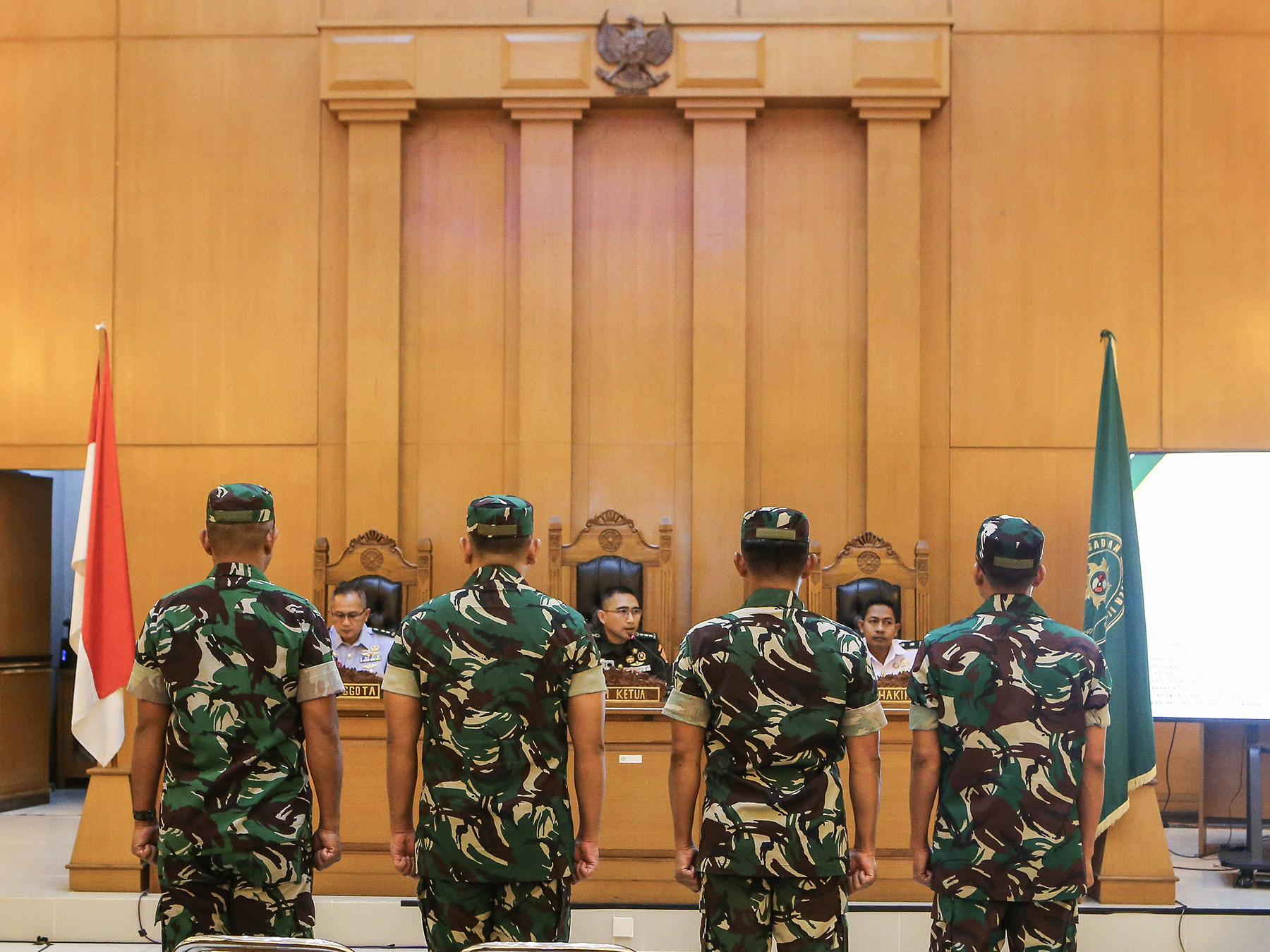
In court, the four soldiers claimed they had planned the assault on Andrie Yunus only two or three days before March 12, 2026. Yet Project Multatuli’s investigation found that Andrie had been under surveillance long beforehand.
A document seen by Project Multatuli suggests that TNI’s Strategic Intelligence Agency (BAIS) had been monitoring Andrie since at least Jan. 30, 2026.
The surveillance covered locations where Andrie lived, worked, and regularly spent time. These included the Commission for Missing Persons and Victims of Violence (KontraS) office, the KontraS safehouse, the Indonesian Legal Aid Foundation (YLBHI) office, and Indonesia Jentera School of Law, where Andrie completed his undergraduate degree.
Two other activists who lived with Andrie at the KontraS safehouse were also monitored.
KontraS Coordinator Dimas Bagus Arya, who obtained the same surveillance document, said it showed a systematic effort to target the three activists and gather information about them.
“The intelligence gathering was linked to Andrie’s activities, particularly after the August 2025 [nationwide protests], when he became involved in the fact-finding process,” Dimas said.
Andrie was indeed part of the Fact-Finding Commission (KPF), which investigated the August 2025 demonstrations and the state violence that followed. The protests erupted amid worsening economic conditions and growing distrust of state institutions.
On Feb. 18, 2026, the commission published a report that, among others, identified four levels of military involvement in the August unrest. Less than a month later, Andrie was attacked with acid.
The military trial, however, never examined the fact that Andrie had been under surveillance long before the attack.
It also failed to address discrepancies between the defendants’ testimony and CCTV footage regarding where they came from before the assault and where they went afterward.
The defendants said they had departed from and returned to the BAIS barracks in Kalibata, South Jakarta. Yet CCTV footage obtained by Project Multatuli clearly shows two of the perpetrators leaving from and later returning to an official BAIS residence on Panglima Polim III Street No. 11, also in South Jakarta.
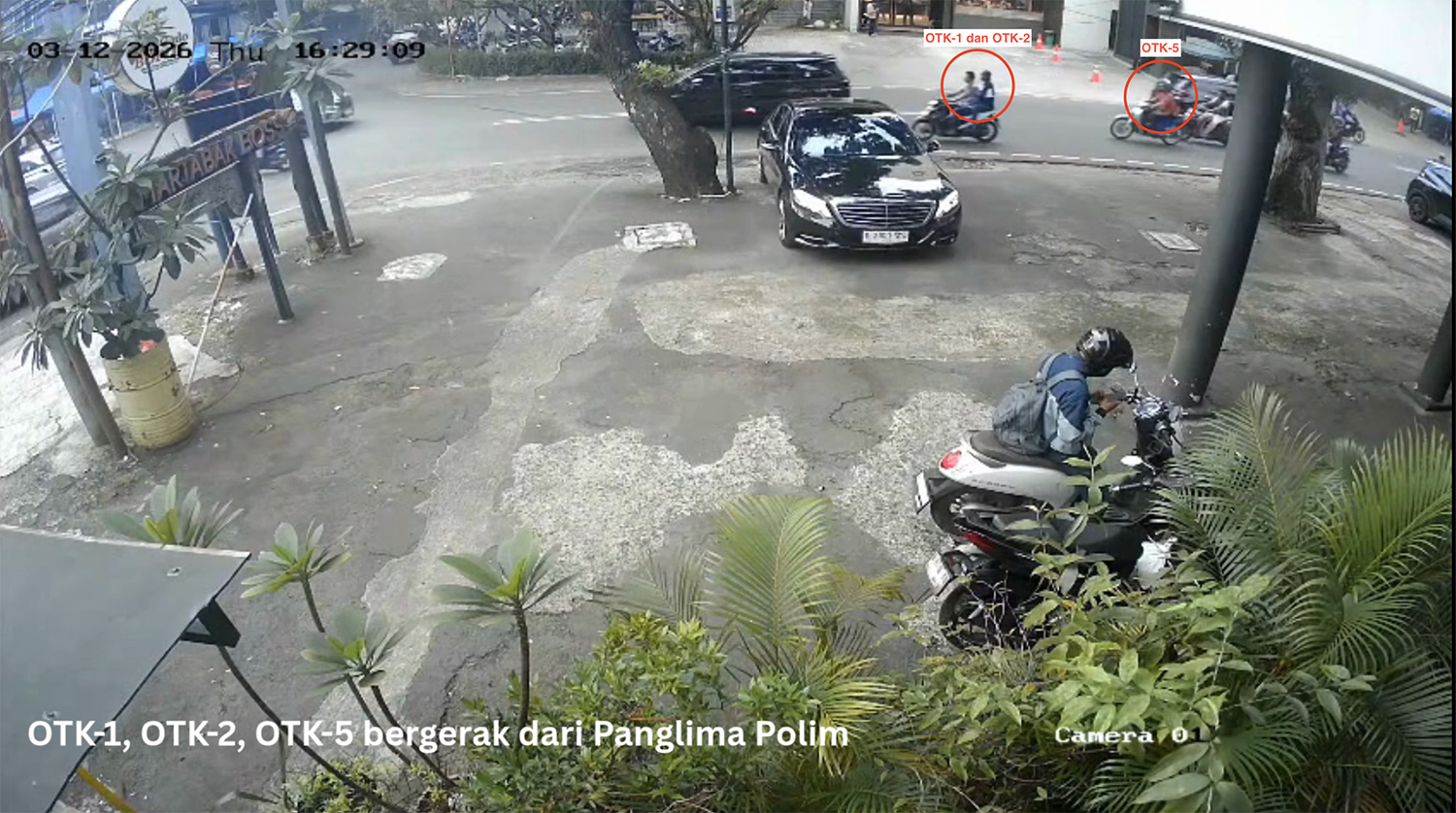
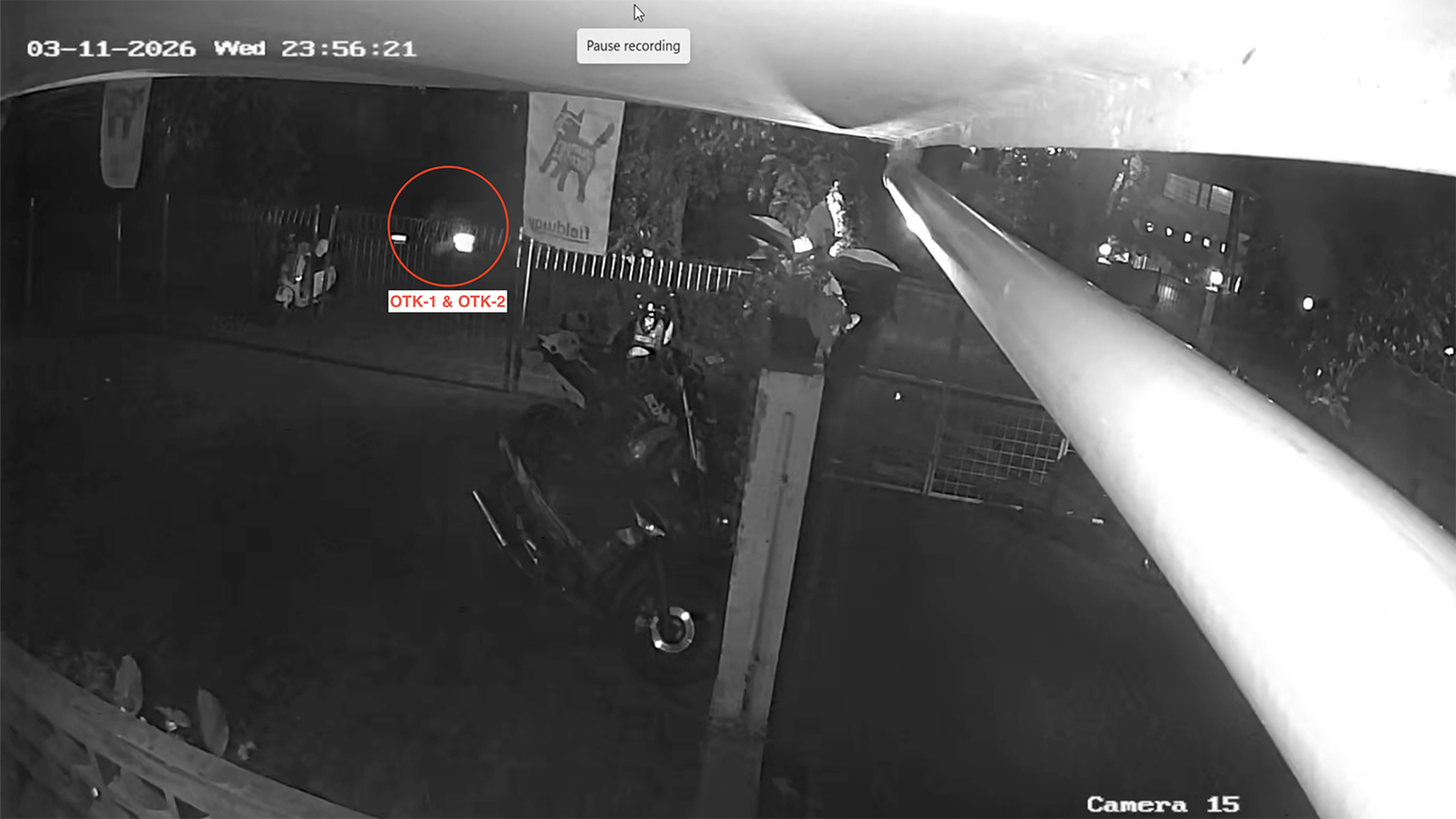
The military trial also left out other field operatives whose identities remain unknown.
Based on its analysis of dozens of CCTV recordings, the Advocacy Team for Democracy (TAUD) found at least 16 people suspected of playing roles in the operation. All were clearly captured on camera and appeared to be communicating and coordinating with one another.
“If anyone says the figure of 16 suspects is inflated, we have evidence showing that other individuals were carrying plastic bags containing tumblers filled with acid before the attack. They were identified as Suspects No. 6 and 7,” said Ravio Patra, an independent researcher and member of TAUD’s investigation team.
Beyond those 16 people, the National Commission on Human Rights (Komnas HAM) noted other individuals and vehicles moving suspiciously around the YLBHI office. There were also others suspected of working behind the scenes or directing the operation remotely.
Through expert testimony presented by the military prosecutor, the trial appeared to reinforce a narrow narrative that the acid attack was driven by a personal vendetta, even though the four defendants had never met or directly interacted with Andrie. The defendants also testified that they had only joined BAIS in November 2025.
The trial also advanced the claim that the defendants had acted spontaneously, without prior planning, preparation, or coordination.
“Was there any prior discussion? Any conversation about how the attack would be carried out or how you would escape afterward?” defense counsel asked during the questioning of the defendants on May 13, 2026.
“None,” Edi Sudarko replied.
“We did not plan it. It was entirely spontaneous,” Budhi Hariyanto Widhi Cahyono told the presiding judge when asked a similar question.
Soleman B. Ponto, former head of BAIS, told the court that the assault was not an intelligence operation, but merely the work of “naughty” soldiers.
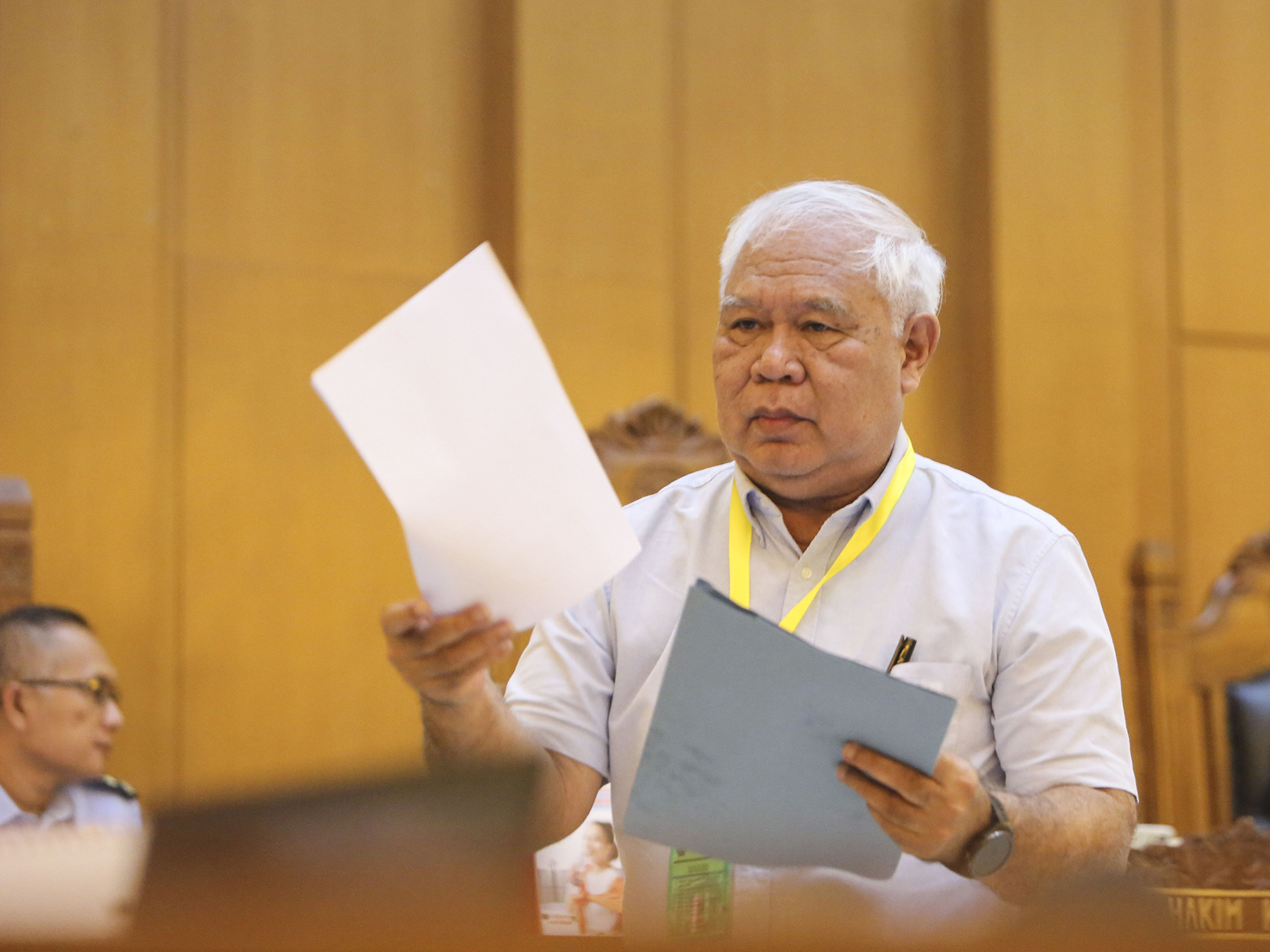
Muhamad Haripin, a researcher with Indonesia’s National Research and Innovation Agency (BRIN), argued that the military trial had itself become “part of the intelligence operation” designed to erase traces of the chain of command.
“From the outset, and based on what I have observed during the trial, I have become increasingly convinced that the acid attack on Andrie Yunus was a carefully planned intelligence operation involving both the defendants and individuals whose roles have yet to be uncovered,” said Haripin, who has written extensively on military and intelligence affairs.
“I suspect the trial is itself part of that intelligence operation. It appears to have been designed from the beginning to determine who would be made the scapegoat.”
Responding to evidence that an Army major was also present on the ground during the attack, Haripin said: “When assessing an intelligence operation, the key question is the chain of command. Did BAIS leadership know about the acid attack?”
In the aftermath of the attack, at least five senior BAIS officials either resigned or were reassigned, including the agency’s head and deputy head.
Two Different Sets of Suspects
On the afternoon of March 18, 2026, the police and the military held separate, nearly simultaneous press conferences, presenting conflicting versions of the men who attacked Andrie Yunus.
The Jakarta Metropolitan Police identified the two main suspects as BHC and MAK, saying BHC was riding the motorcycle while MAK carried out the acid attack. The police also said the number of perpetrators could exceed four.
Meanwhile, the Indonesian Military Police Center (Puspom TNI) named four suspects: ES, BHW, NDP, and SL. Its version identified ES, not MAK, as the person who threw the acid.
BHC and BHW turned out to be the same person: Budhi Hariyanto Widhi Cahyono. ES, or Edi Sudarko, however, is not the same individual as MAK.
The military built its version on a separate internal investigation conducted by its Strategic Intelligence Agency (BAIS).
Colonel Heri Heryadi, commander of BAIS’s Headquarters Detachment (Denma), told the court that he became suspicious after Budhi and Edi missed several morning roll calls, claiming they were ill.
At the BAIS medical facility, Heri said, he found both men with burn injuries. Edi had burns on his face, right eye, the right side of his neck, chest, and right arm. Budhi had burns on his right arm.
According to Heri, the two later admitted to taking part in the acid attack on Andrie.
On the other hand, the police said they identified Budhi and MAK after reviewing footage from 86 CCTV camera points. Investigators then reconstructed the suspects’ facial features from the footage and compared them with police database records.
Several sources told Project Multatuli that the man identified by police as MAK was an Army soldier posted to the Regional Military Command (Kodam) XVII/Cenderawasih in Jayapura, Papua.
Social media accounts belonging to MAK’s wife suggest that he served as an intelligence officer at Kodam XVII/Cenderawasih. His wife is a member of Persit Kartika Chandra Kirana, the Army’s spouses’ organization, and is affiliated with the command’s intelligence unit. Records also place the couple’s residence in Jayapura.
A source in Jayapura who had previously met MAK corroborated this account.
“Yes, his name is A****. He works in military intelligence at the regional command,” the source said, adding that he had last seen MAK around two months earlier.
After being shown CCTV footage of the suspected attacker, he said the man looked “very similar”, with only slight differences, particularly around the nose. He cautioned, however, that he could not be certain because of the poor quality of the footage.
Colonel Tri Purwanto, spokesperson for Kodam XVII/Cenderawasih, denied that MAK had ever served there.
“The individual concerned has never been posted to Kodam XVII/Cenderawasih,” he said.
The police had also previously mentioned two other unidentified individuals on a separate motorcycle who were trailing Budhi and MAK as they followed Andrie toward Salemba I Street. The two then fled toward Pramuka Street, while Budhi and MAK rushed in the opposite direction, back toward Diponegoro Street.
In the military’s version, the two individuals on the second motorcycle were Nandala Dwi Prasetya and Sami Lakka.
At the military trial, Nandala testified that he rode with Sami on a Yamaha Mio Soul bearing the registration number B 3334 CLK.
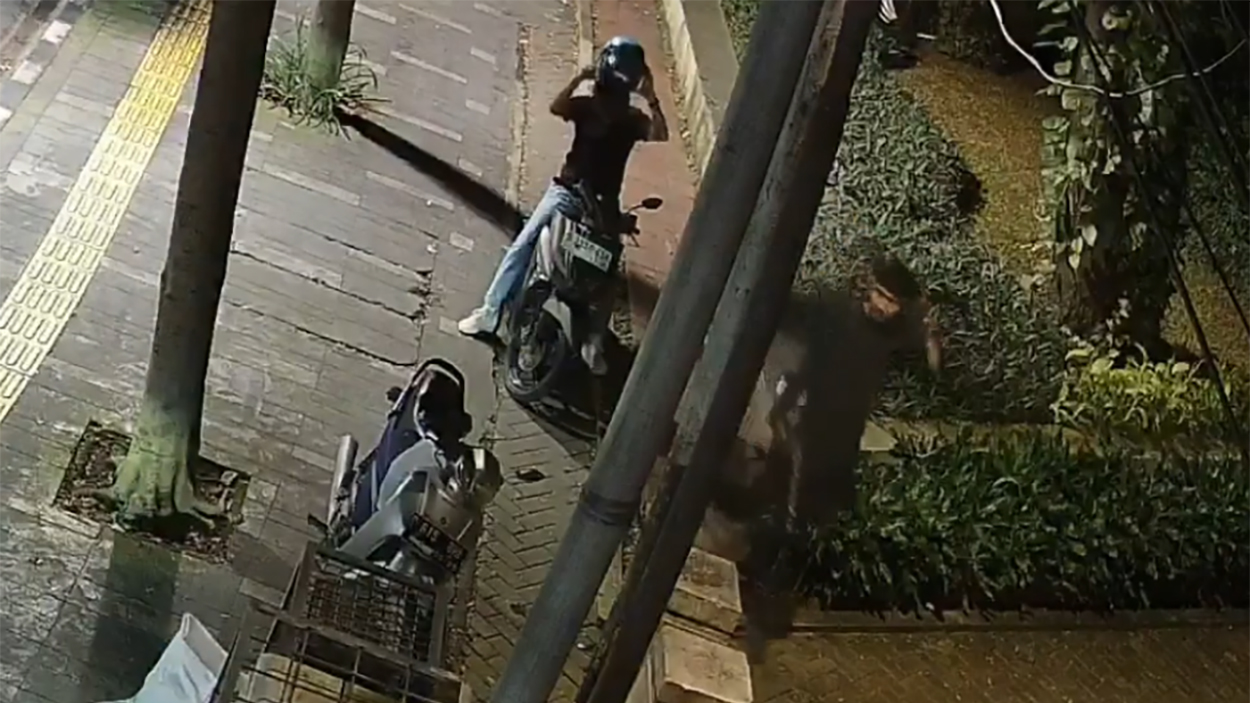
Ravio Patra, an independent researcher involved in the Advocacy Team for Democracy’s (TAUD) investigation, said a Yamaha Mio Soul with the same registration number indeed appeared in CCTV footage from the night of the attack. The motorcycle was ridden by two unidentified individuals labeled Suspects No. 3 and 4.
But according to Ravio, the physical appearance of the two individuals captured in the CCTV footage does not resemble Nandala and Sami.
“Nandala Dwi Prasetya is heavily built, with a large stomach, and appears to be in his forties. The rider of the Yamaha Mio Soul [Suspect No. 3], by contrast, has a slim build and appears much younger,” Ravio said.
“Sami Lakka is not especially tall, while the passenger, Suspect No. 4, appears tall and broad. The visuals do not match.”
The police analysis also described Suspect No. 3 as slim, approximately 165 to 170 centimeters tall, with medium-brown skin. He appeared relatively young, around 30 years old. Suspect No. 4, meanwhile, was described as tall and stocky, with a darker complexion.
“Why are Nandala and Sami prosecuted [in the military court] when their visuals do not match [Suspects No. 3 and 4] as captured on CCTV? We think it is entirely possible that Suspects No. 3 and 4 are not military personnel at all, but civilians,” Ravio said, adding that TAUD continues to investigate that possibility.
“Our working assumption is that a suspect is a civilian unless we have evidence confirming that they are, in fact, military personnel. That is why we need the police to continue their investigation.”
Intelligence Operation, Civilian Victims
Muhammad Hidayat, a resident of Talang Street in Central Jakarta, witnessed the acid attack on Andrie Yunus and was called to testify before the military court on May 6, 2026.
“At first, I heard someone screaming. Then I saw a motorcycle lying on the ground and a man standing nearby, shouting,” he recalled.
Hidayat initially assumed that Andrie had been mugged.
“What happened? Were you mugged?” he asked.
“No,” Andrie replied. “Acid.”
Hidayat tried to chase the attackers using Andrie’s motorcycle, which had been left lying on the ground after the assault. But less than 100 meters from the scene, as he headed toward Dr. Cipto Mangunkusumo Hospital (RSCM), he decided to turn back after noticing a sharp chemical odor from the motorcycle.
“The smell was extremely sharp,” he told the court.
He also felt a burning sensation from acid residue left on the motorcycle seat. The next day, he discovered that the back of his shorts had been damaged by the chemical.
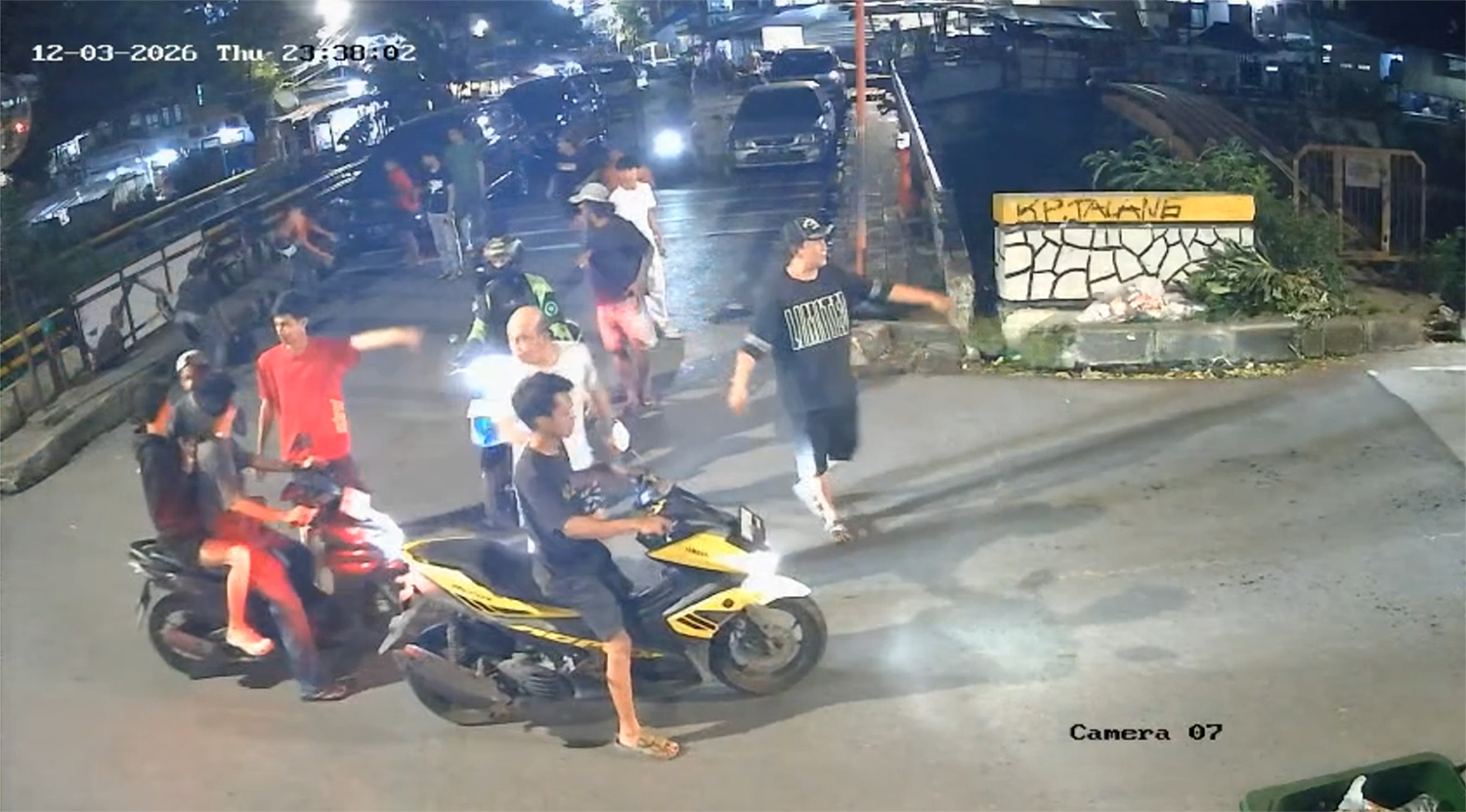
Andrie Yunus was not the only civilian harmed by the military operation. Project Multatuli found that the perpetrators misappropriated the national ID numbers (NIK) of at least two civilians to register new phone numbers allegedly used to communicate during the operation.
One victim of the identity theft is a 78-year-old man from Lebak, Banten, identified only by the initial U. When Project Multatuli visited his home, he was lying ill in the living room. His wife and children said he had long suffered from a serious illness that left him struggling to breathe and swallow, and confined him to bed.
He had never owned or used a mobile phone.
“This is his condition,” one of his children said. “He has been like this for years. He cannot go anywhere. Even his basic needs have to be taken care of here. He is seriously ill.”
Asked whether anyone in the family served in the military, U’s wife, who spoke little Indonesian, replied in Sundanese: “No. We are just ordinary people. None of us went to school.”
Their three children care for U while working as farmers and garment workers. They received only primary or junior secondary education.
Another victim was S, a housewife in Serang, Banten. She is a recipient of the Family Hope Program (PKH), a social assistance scheme for low-income households.
When informed that her NIK had allegedly been used in connection with a criminal act, S recalled that a group of men had once visited her home and asked for a photocopy of her identity card, claiming it was needed to support a business venture.
“They said they were from the government. There were three of them, all men,” S said. “After that, we never heard from them again.”
The misuse of civilian identities extended beyond NIK theft. Evidence suggests that at least one motorcycle used in the operation was still registered under a civilian’s name.
CCTV footage shows Suspect No. 16 riding a Honda Scoopy bearing the registration number B 3**6 PGG. The motorcycle was registered to a woman identified only by the initial V, who lives in Central Jakarta.
Further investigation found that its ownership records had not been updated after a leasing company repossessed it in December 2025. In January 2026, a used motorcycle dealer advertised it for sale on social media.
The dealer said the motorcycle had been sold but was returned by the buyer in early May 2026. The buyer’s identity remains unknown.
Project Multatuli visited V’s workplace, but she was not there. A security guard confirmed that V, who works as a cleaner and cares for her chronically ill mother, had previously used the motorcycle to commute but had stopped doing so some time earlier.
The guard confirmed that the motorcycle had been repossessed by a leasing company after V fell behind on her repayments. He also said V had previously offered to sell it to several colleagues.
We also asked whether the person captured on CCTV resembled anyone in V’s family, including her older brother. The guard ruled it out.
“They do not look alike. Her brother is much slimmer,” he said.
Identity Misuse in Military Court
The misuse of civilian identities also surfaced during the military trial.
In its indictment, the prosecutor said Budhi Hariyanto Widhi Cahyono and Edi Sudarko, identified by the military as the two main perpetrators of the acid attack on Andrie Yunus, rode a Honda Beat bearing the registration number F 3151 BY. The motorcycle was said to belong to Nandala Dwi Prasetya.
This claim was made even though CCTV footage showed that the license plate on the motorcycle used by the two main perpetrators began with the letter F and the digit 2.
Project Multatuli’s investigation also found that F 3151 BY was registered not to a Honda Beat, but to a Kawasaki Ninja 250 motorcycle. Its registered owner is AM, a 62-year-old civilian living in the Cilendek area of Bogor, West Java.
“Yes, that is my registration number. But my motorcycle is a [Kawasaki] Ninja 250. I have never owned a Honda Beat,” AM said when Project Multatuli visited his home.
“How could this happen? This is clearly falsification.”
Cilendek is home to the main training center of the military’s Strategic Intelligence Agency (BAIS). During the first hearing, the court heard that Budhi had attended an intelligence course there in 2025.
Moreover, the prosecutor said Nandala and Sami Lakka followed Budhi and Edi on a second motorcycle: a Yamaha Mio Soul with the registration number B 3334 CLK, owned by Sami.
But vehicle registration records show that B 3334 CLK belongs not to a Yamaha Mio Soul, but to a Honda Beat. Its registered owner is not Sami, but a civilian identified only by the initial M.
Project Multatuli visited M’s neighborhood in Tangerang, Banten. The local neighborhood chief said two residents shared the same name, both living in rented accommodation in the area. One worked in a factory, while the other sold chicken noodles from a mobile cart.
During the hearing on May 13, 2026, Sami was unable to recall the registration number of the motorcycle he had repeatedly claimed was his own.
“I only remember that it ends in three Cs,” he said.
Rather than asking why Sami could not remember the registration number of his own motorcycle, the military prosecutor read out the correct number for him.
The Case for Military Justice Reform
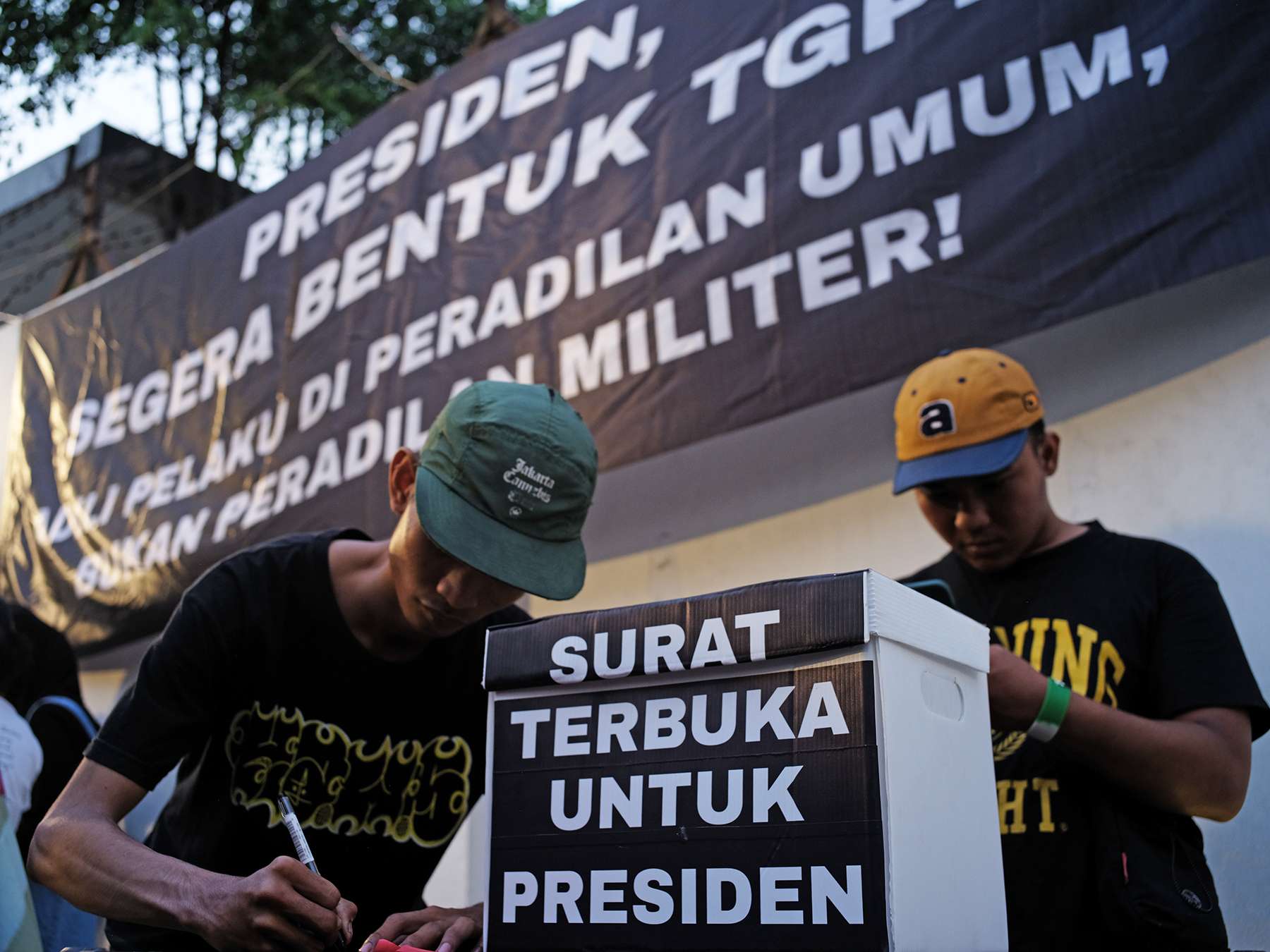
Speaking to journalists on March 17, 2026, President Prabowo Subianto vowed that the acid attack on Andrie Yunus would be fully investigated.
“We must investigate this thoroughly. Not only the field operators, but also those who ordered and financed it. We must uncover the masterminds,” he said.
About three months later, however, the military trial ended without uncovering all those involved in the operation, let alone those who may have ordered or directed it.
On June 10, the Jakarta Military Court II-08 sentenced Edi Sudarko to three years in prison and Budhi Hariyanto Widhi Cahyono to two years and six months, dismissing both from military service.
Nandala Dwi Prasetya received a two-year sentence, while Sami Lakka was sentenced to one year and six months. Neither was dismissed from the military.
The four defendants have since appealed the verdicts.
For criminal law expert Maidina Rahmawati, the way the case was handled underscored the need to reform Indonesia’s military justice system.
Under the 1997 Military Court Law, Indonesian military courts have jurisdiction over soldiers accused of criminal offenses.
The 2004 Indonesian Military (TNI) Law actually introduced a different rule. Article 65 states that military personnel accused of ordinary crimes should be tried in civilian courts. Article 74, however, delays the implementation of that rule until a new military court law is enacted, leaving soldiers subject to the 1997 law.
Today, more than two decades after the 2004 TNI Law was passed, the 1997 Military Court Law remains unchanged. The 2025 revision of the TNI Law also left Article 74 intact.
Maidina, who teaches criminology at the University of Indonesia and works as a researcher at the Institute for Criminal Justice Reform, said President Prabowo has the authority to issue a Government Regulation in Lieu of Law (Perppu) to address the issue.
“We need to urge President Prabowo to issue a Perppu repealing Article 74 of the TNI Law,” Maidina said.
“The Perppu would pave the way for broader reform of the military justice system, restricting military courts to disciplinary matters rather than criminal offenses committed against civilians.”
Under the new Criminal Procedure Code (KUHAP), which took effect on Jan. 2, 2026, civilian courts may still assert jurisdiction through koneksitas, a joint-jurisdiction mechanism for cases involving both civilian and military defendants. Article 170 provides that such cases must be examined and tried within the civilian court system.
The same article further requires such cases to be investigated jointly by civilian investigators and military police, under the coordination of civilian and military prosecutors.
Because the National Police (Polri) opened the investigation into the acid attack, Maidina argued that it should also have the authority to pursue a joint-jurisdiction process.
“The police initiated the investigation. If they believe the military investigation is compromised by a conflict of interest, they should be able to continue investigating the case themselves,” she said.
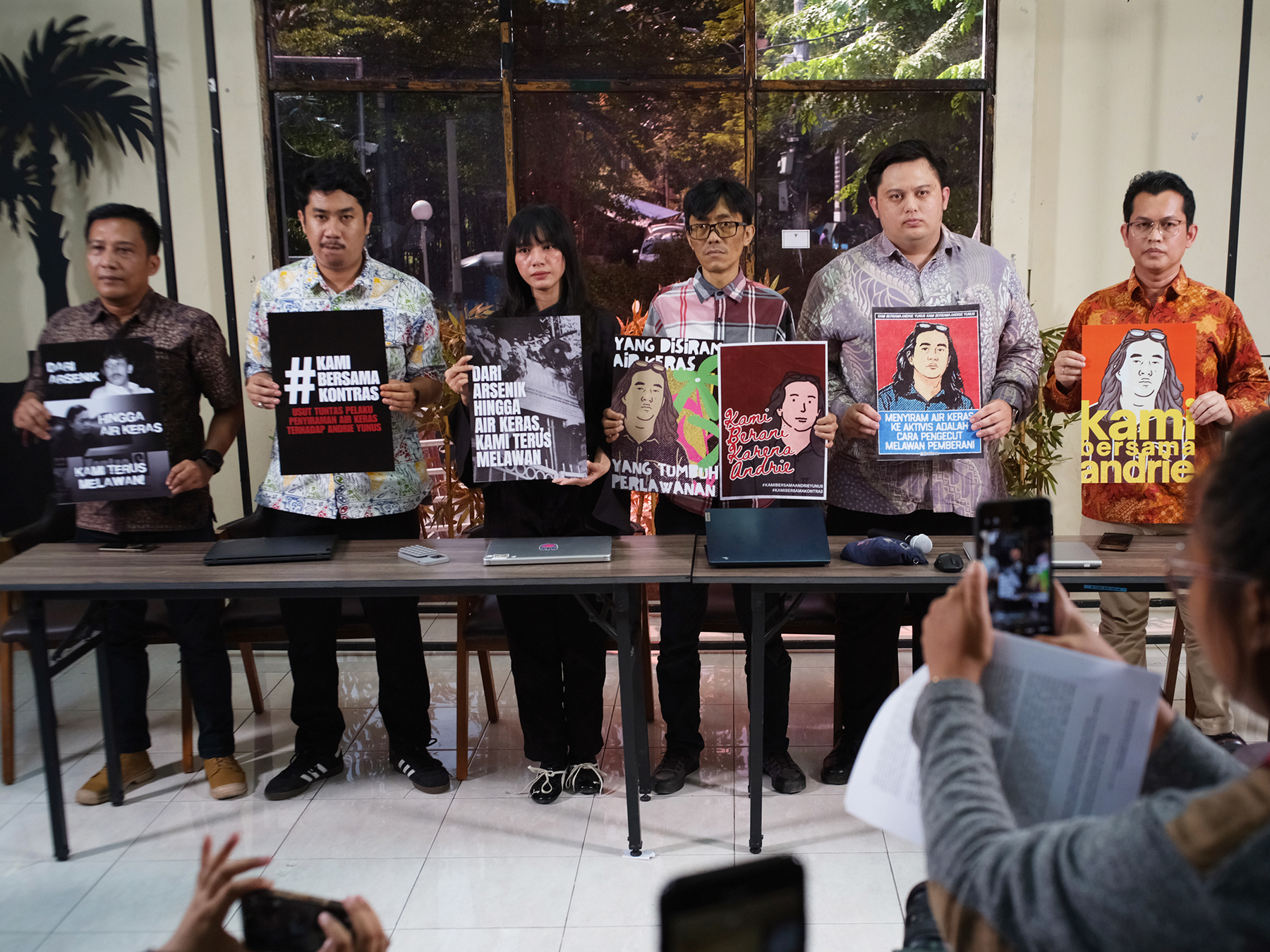
On April 29, 2026, the Advocacy Team for Democracy (TAUD) filed a pretrial motion with the South Jakarta District Court, challenging the legality of the Jakarta Metropolitan Police’s decision to halt its investigation after the case was transferred to the military police.
Although the case file had been handed over, TAUD said it had never received a formal Order of Termination of Investigation (SP3) from the police.
The respondents in the pre-trial proceedings were Jakarta Metropolitan Police Chief Asep Edi Suheri and General Criminal Investigation Director Iman Imanuddin.
At a hearing on May 21, the police’s legal team denied that the investigation had been terminated.
“We are still actively carrying out investigative measures,” a police representative told the court.
“The evidence and copies of supporting materials were transferred to the military police solely for coordination purposes.”
On June 2, the South Jakarta District Court granted TAUD’s motion and ordered the police to continue the legal process in Andrie’s case.
Apart from the pretrial motion, TAUD also formally reported the acid attack on Andrie to the National Police’s Criminal Investigation Agency (Bareskrim) on April 8. Bareskrim later referred the case back to the Jakarta Metropolitan Police, saying its location, timing, and substance were identical to those of the existing investigation.
On May 19, members of TAUD’s investigation team were questioned by the Jakarta Metropolitan Police. They submitted evidence showing the alleged involvement of 16 suspects in the operation, based on their analysis of CCTV footage.
“The evidence we presented consisted of a 130-page chronology accompanied by CCTV stills,” said Ravio Patra, an independent researcher and member of TAUD’s investigation team.
“In total, we submitted 180 photographs and 81 CCTV clips from locations across Jakarta, documenting the movements of both the victim and the perpetrators on March 12, 2026.”
On June 17, TAUD members were questioned again as witnesses in relation to the report. Afterward, they urged the police to elevate the case from a preliminary inquiry to a formal criminal investigation.
Recovery and Resistance
Andrie Yunus’s condition has gradually improved since the acid attack. As of June 2026, he is no longer hospitalized and continues to recover as an outpatient.
Ophthalmologist Faraby Martha previously said Andrie’s chemical eye injury was classified as Grade 3 on a four-grade scale, meaning it was severe.
Faraby said Andrie’s chances of regaining his sight remained uncertain, though she was doubtful. Before surgery, the acid had penetrated deeply enough to dissolve part of the wall of his eyeball.
“Andrie cannot read even the largest letters because his vision is extremely poor. He can only distinguish between light and darkness,” Faraby testified at a military court hearing on May 20, 2026.
Dimas Bagus Arya, the coordinator of the Commission for Missing Persons and Victims of Violence (KontraS), said Andrie’s chances of regaining some vision depended on whether doctors could preserve his eyeball.
“As long as the eyeball can be preserved, there remains a meaningful possibility of improving its visual function. If it cannot be saved, he will need a prosthetic eye,” he said.
As he continues his recovery, Andrie remains steadfast in his view that his case should never have been tried in a military court.
As KontraS deputy coordinator, Andrie has devoted much of his work to security sector reform. That experience has shaped his view of military courts as institutions that perpetuate impunity for service members accused of criminal offenses.
On April 28, Andrie submitted a letter to the Constitutional Court as part of a judicial review of the 1997 Military Court Law. Dimas, who appeared as a witness for the petitioners, read the letter aloud.
In the letter, Andrie rejected the military court’s jurisdiction over his case and described military courts as “a haven of impunity for military personnel” who committed human rights violations.
On another occasion, Dimas conveyed Andrie’s view that all ordinary crimes should be tried in civilian courts, “regardless of their uniforms, ranks, or status”.
“We may all agree that civilian courts do not automatically guarantee justice,” Dimas said. “But at the very least, Andrie’s position is grounded in constitutional principles.”
KontraS and the entire legal team representing Andrie support his position.
“We agree,” Dimas said.
“Andrie’s position reflects what civil society has long fought for: security sector reform, particularly within the TNI. That includes reforming a military justice system that is no longer compatible with a modern state governed by the rule of law.”
Editor’s note: On May 22, 2026, Project Multatuli contacted Major General Yusri Nuryanto, commander of the Indonesian Military Police, to ask about the investigation conducted by his office before the case was transferred to the Military Prosecutor’s Office. He had not responded by the time this article was published.