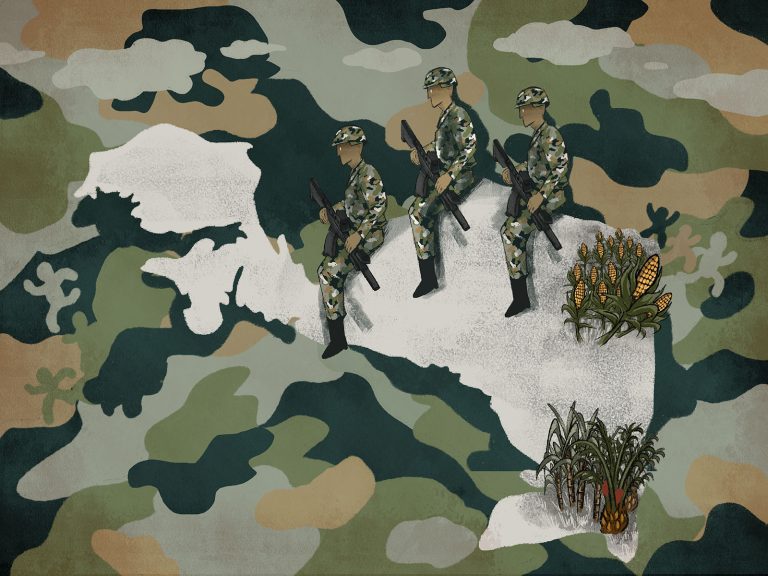

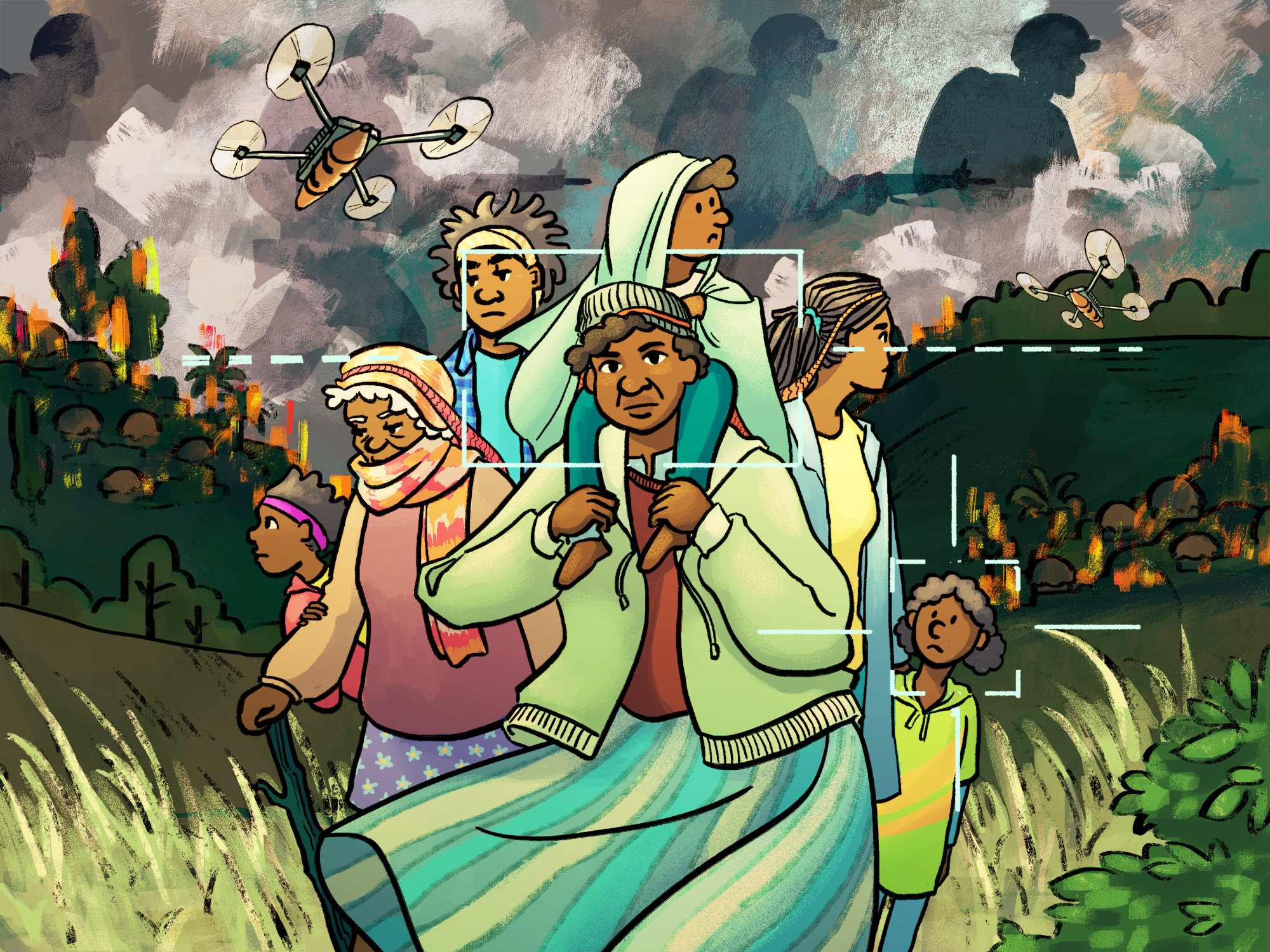
Thousands of rotational soldiers move in and out of Papua. They fight, guard state projects, and leave civilians under a seemingly endless shadow of guns.
- Papua now hosts 74,297 soldiers. Of those, 17,780 are rotational troops drawn from across Indonesia. The cost of mobilizing them and sustaining their operations in Papua is estimated at Rp2.34 trillion (around US$129.5 million) a year.
- The density of military and police personnel in Papua is about six times the national average.
- Military operations in Papua have displaced more than 122,000 Papuans over the past eight years.
- Judging by the scale, structure, and ways the military operates in Papua, what is happening there resembles a military occupation.
Each year, the Prabowo Subianto administration spends trillions of rupiah to deploy 17,780 rotational soldiers from across Indonesia to Papua and sustain their operations. The troops are deployed across 31 regencies, nearly three-quarters of Papua’s second-tier administrative regions.
The Indonesian military calls these troops “non-organic” forces, meaning they do not belong to units permanently based in Papua. Instead, they rotate in from bases elsewhere in Indonesia for temporary assignments, typically lasting no more than a year. During their deployment, they are placed under the operational control of local military units through a mechanism known as BKO.
They differ from “organic” forces, or soldiers assigned to Papua-based units. Together, these units make up the standing garrison.
The rotational soldiers sent to Papua come from all three branches of the Indonesian Military (TNI): the Army (AD), the Navy (AL), and the Air Force (AU). The vast majority, however, come from the Army.
Traveling aboard Navy warships, they arrive from military bases across Indonesia, including Padang, Lumajang, Kupang, Mempawah, Gorontalo, and Namlea.
Once in Papua, these soldiers typically join various task forces, locally known as satgas. These include the Border Security (Pamtas) Task Forces along the Indonesia-Papua New Guinea (RI-PNG) border and the Vulnerable Area Security (Pamrahwan) Task Forces.
Pamtas Task Forces are further divided into three types: static, territorial, and mobile.
Static Pamtas units guard military posts along the border. Territorial Pamtas units conduct non-combat operations in residential areas, such as distributing food and clothing and providing health services. Through these activities, the TNI seeks to win support among Papuan communities.
Meanwhile, Mobile Pamtas units conduct combat operations in areas the military considers security risks. Made up of personnel from multiple units, these task forces operate under the TNI Habema Operations Command.
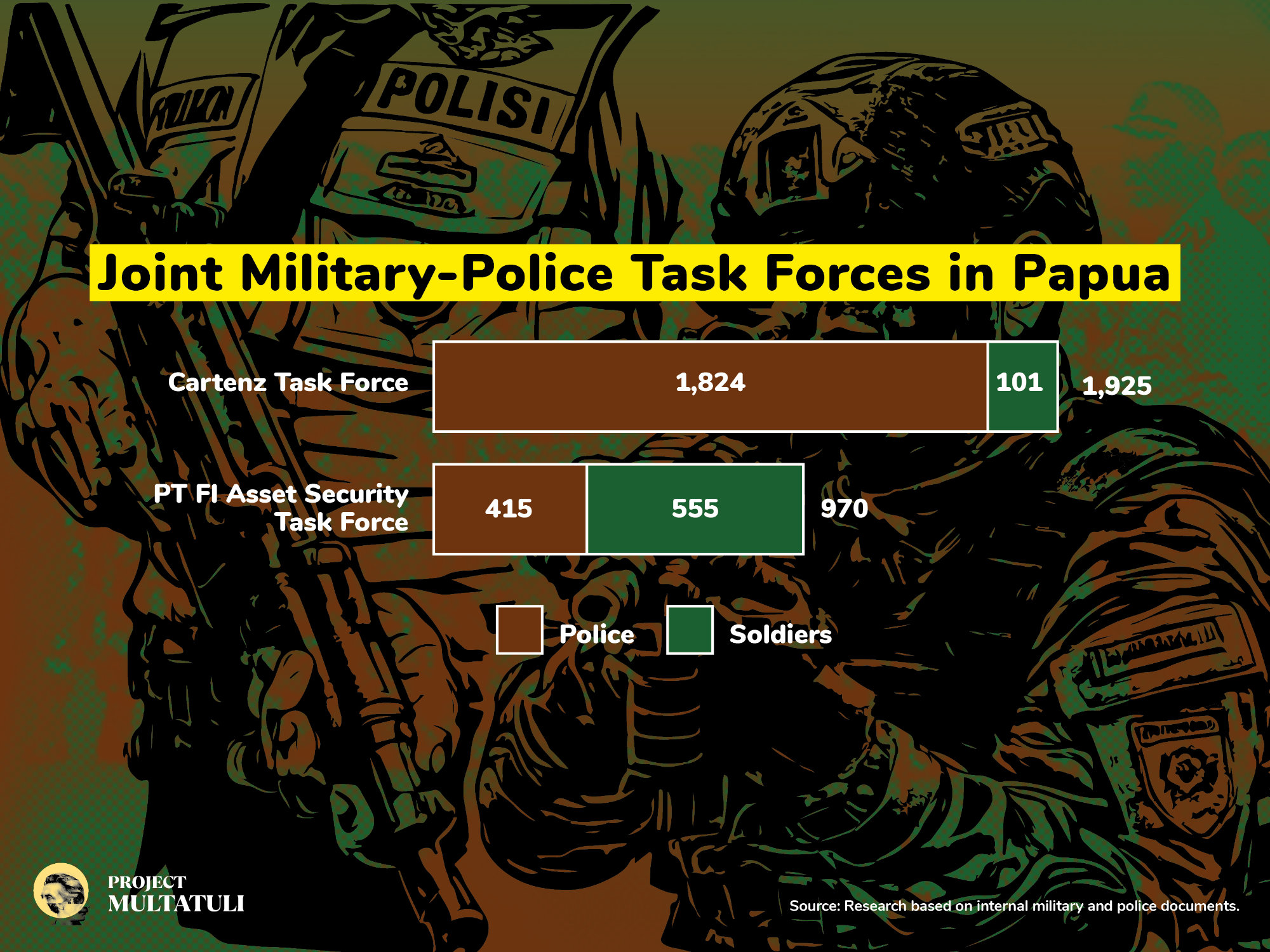
Joint military-police task forces also operate in Papua. These include the Cartenz Task Force, which according to authorities focuses on “law enforcement”, and the Amole Task Force, which guards PT Freeport Indonesia’s giant gold mine. The government has formally designated the mine a “nationally vital asset”, a legal classification that authorizes military protection. The police command both task forces.
Yet since Prabowo Subianto became president, the military has increasingly replaced the police at the forefront of security operations in Papua. In practical terms, Papua can now be described as a military operations zone.
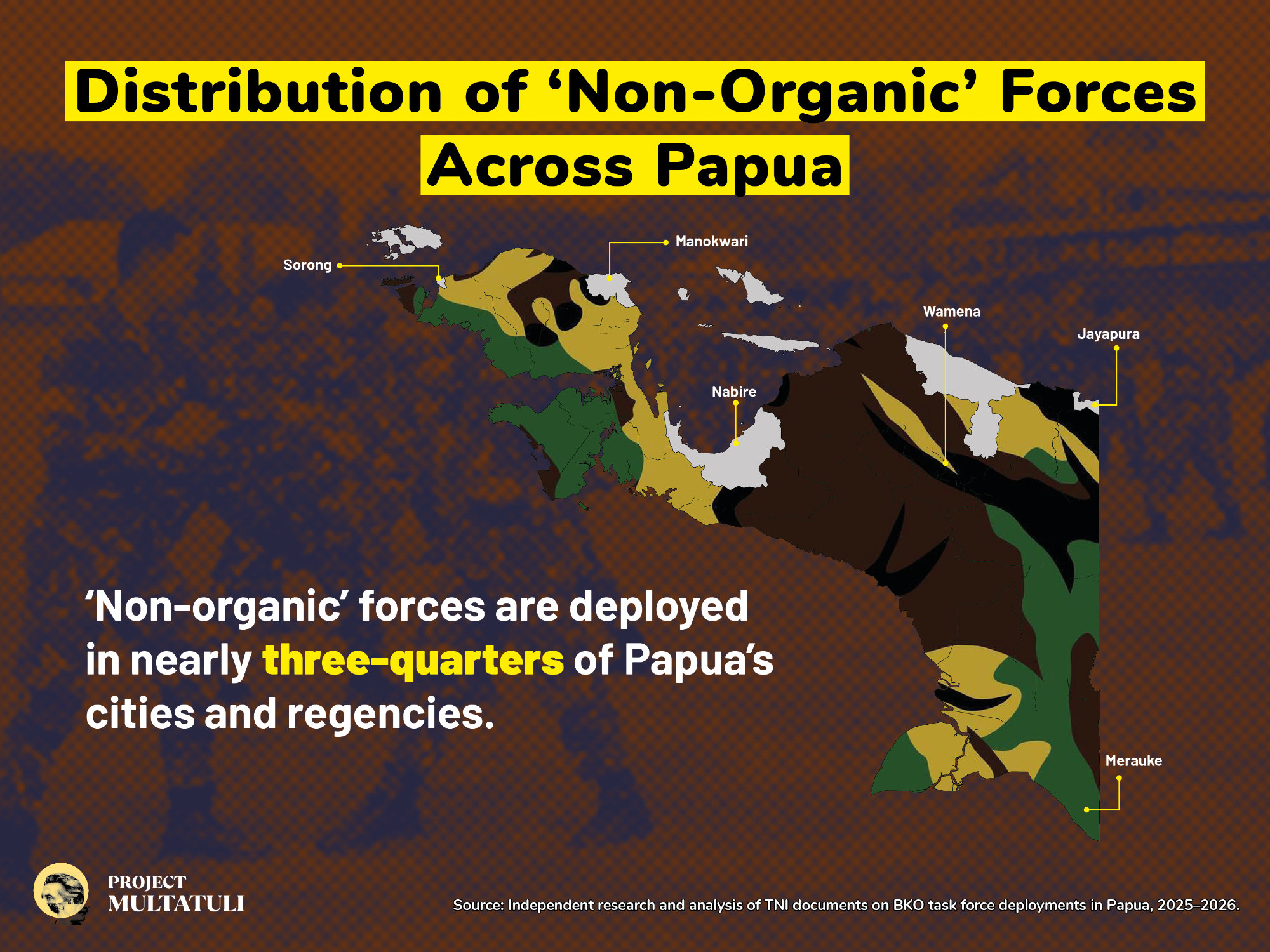
For example, Infantry Battalion (Yonif) 643/Wanara Sakti under Military Regional Command (Kodam) XII/Tanjungpura in West Kalimantan was deployed to Keerom, Papua, from August 2025 through August 2026. The unit was assigned to a Static Pamtas RI-PNG Task Force.
A social media video uploaded in May 2026 documented the presence of Yonif 643/Wanara Sakti in Papua. In the video, soldiers from the battalion appear to organize schoolchildren to dance with Bobon Santoso, a YouTuber who regularly produces TNI content in Papua.
Elsewhere, Yonif 623/Bhakti Wira Utama under Kodam VI/Mulawarman in East Kalimantan serves in a Mobile Pamtas RI-PNG Task Force in Puncak Jaya, Central Papua, from January 2026 through January 2027.
Aprianus, a private first class fatally shot by a pro-independence militia in late April 2026, served with Yonif 623/Bhakti Wira Utama.
In Maybrat, Southwest Papua, a Mobile Pamtas RI-PNG Task Force is staffed by personnel from Yonif 9 Marinir, a Navy unit based in Pesawaran, Lampung.
Maybrat, along with Yahukimo in Highland Papua, frequently serves as a deployment site for rotational Navy troops.
In Puncak, Central Papua, Para Commando Battalion (Yon Parako) 466 of the Air Force’s Rapid Deployment Corps (Korpasgat) has been deployed from Makassar, South Sulawesi.
Maj. Gen. Yudha Airlangga, commander of the TNI Habema Operations Command, visited the Korpasgat post in Sinak District, Puncak, in April 2026. Soldiers from Yon Parako 466 were seen escorting his entourage.
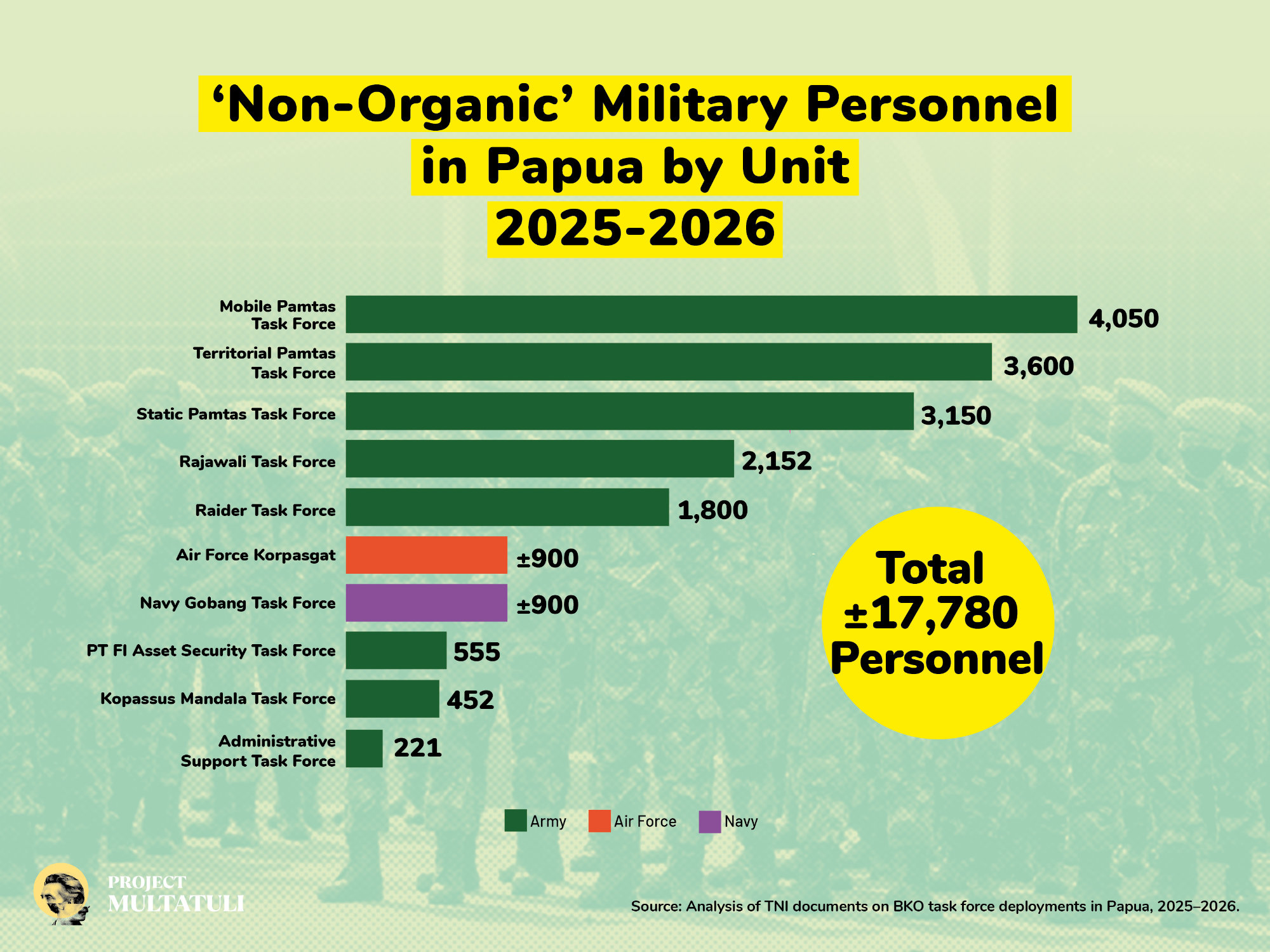
Based on troop mobilization data cross-checked against multiple sources, we found around 40 rotational battalion task forces currently deployed across Papua. These task forces typically comprise 400 to 450 soldiers each. Altogether, 17,780 rotational troops are serving in Papua.
Our earlier investigation, “A Lopsided War“, found at least 56,517 TNI personnel assigned to units based in Papua. Adding the rotational troops brings the total military presence to 74,297 soldiers.
In addition, 26,660 National Police (Polri) personnel are assigned to units under Papua’s two Provincial Police Commands (Polda), while another 2,239 rotational personnel serve with the Cartenz and Amole task forces. This puts the number of police personnel in Papua at 28,899.
The military and police therefore have a combined 103,196 personnel in Papua.
Even by conservative estimates, that figure is extraordinarily high relative to Papua’s civilian population.
According to Statistics Indonesia (BPS), Papua’s population stands at 5.9 million in 2026. That works out to one security officer for every 57 civilians.
By comparison, Indonesia’s population is 287.2 million this year, while the TNI and National Police have a combined 868,748 active personnel. Nationally, there is one security officer for every 331 residents.
In other words, the density of soldiers and police in Papua is roughly six times the national average.
The data also show that the military and police station about 12% of their personnel in Papua, home to only 2% of Indonesia’s population.
Rp2.34 Trillion for Rotational Operations
Deploying thousands of rotational soldiers to Papua carries an enormous price tag. We estimated how much public money the state spends to run its war machine in Papua.
Two main components go into the calculation: personnel support and operational support.
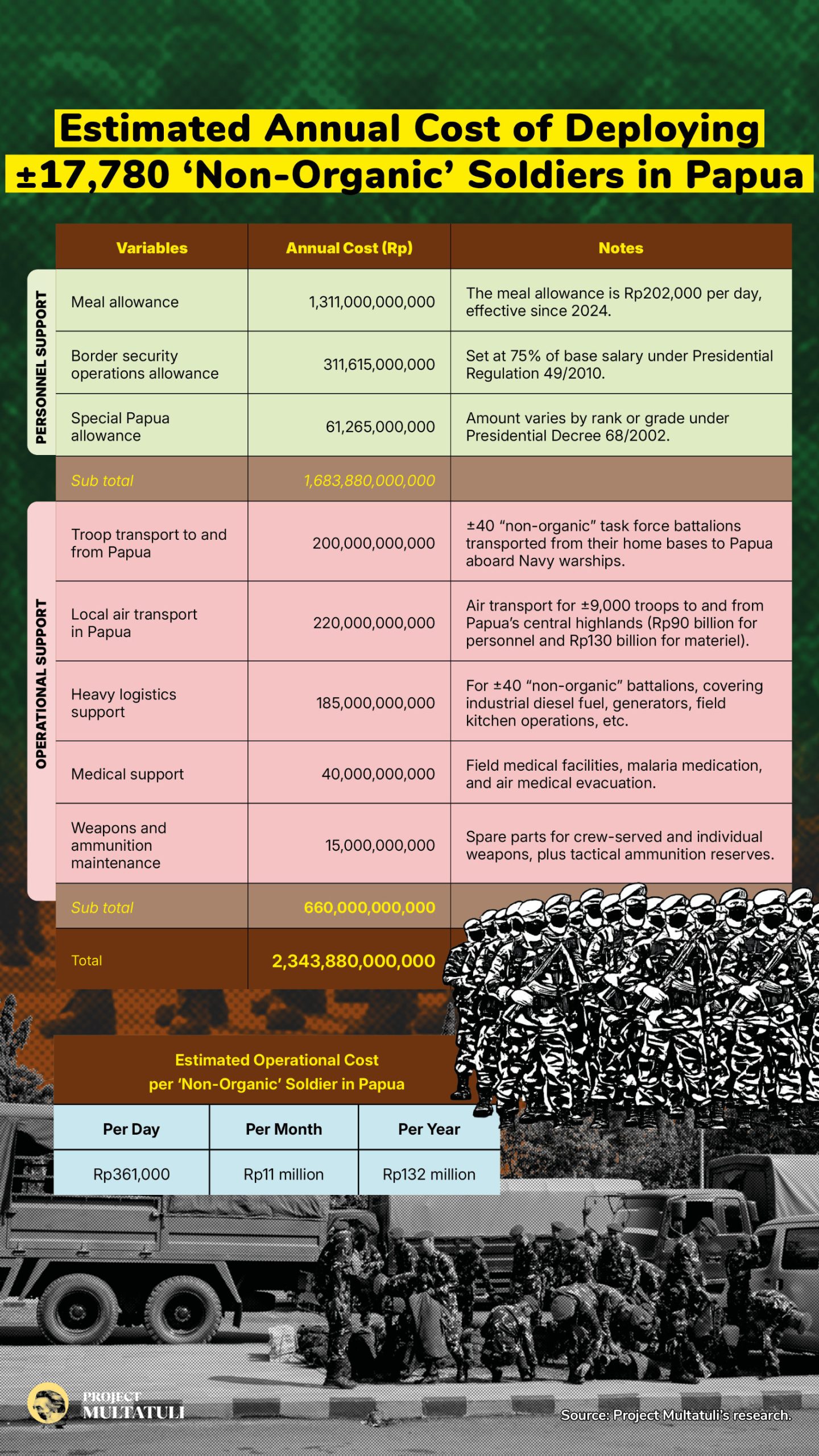
For personnel support, the first cost variable is the daily meal allowance for special operations in Papua, set at Rp202,000 per day.
This allowance took effect in 2024, following an agreement reached in a meeting between President Joko Widodo, Finance Minister Sri Mulyani, National Development Planning Minister Suharso Monoarfa, Defense Minister Prabowo Subianto, and TNI Commander Gen. Agus Subiyanto in late 2023.
Assuming the allowance is paid for a full year to 17,780 rotational soldiers in Papua, the ration costs alone total Rp1.31 trillion.
Beyond that, the House of Representatives’ Commission I held a closed-door meeting with Gen. Agus in July 2024 to discuss an “operational allowance” for TNI soldiers serving in Papua. Reports put the amount at Rp97,000 per day.
Because it remains unclear whether that proposal was ever enacted, we chose not to include the operational allowance in our calculations.
The next variable is the special Papua allowance, based on Presidential Decree 68/2002, which has never been revised. The amount varies according to the soldier’s rank or grade.
There is also a border security operations allowance. Under Presidential Regulation 49/2010, soldiers receive an allowance equal to 75% of their base salary.
In an April 2025 meeting with Commission I, Defense Minister Sjafrie Sjamsoeddin proposed increasing the special Papua allowance by 60% to 65%, as well as raising the border security operations allowance by 75% to 100%.
He placed particular emphasis on the special Papua allowance, which had not been increased since 2002.
“From 2002 to 2024, it never went up,” Sjafrie said.
“Inflation went up and down, up and down. The dollar went up and down, up and down. But the allowance stayed the same.”
Even so, there has been no apparent follow-up to the proposed increases.
To calculate the two allowances, we used the personnel profile of an infantry battalion (Yonif) deployed to Papua under the operational control mechanism known as BKO, drawing on internal TNI documents.
The battalion consists of 450 soldiers: one mid-ranking officer (a major) as task force commander, 26 junior officers, 73 noncommissioned officers, and 350 enlisted soldiers.
We applied that composition to the full force of 17,780 rotational soldiers, equivalent to roughly 40 battalion task forces in Papua. All soldiers were assumed to receive the lowest base salary for zero to one year of service.
Based on that calculation, the annual estimates came to Rp311 billion for the border operations allowance and Rp61.2 billion for the special Papua allowance.
Combined with Rp1.31 trillion in ration costs, funding the operations of 17,780 rotational soldiers in Papua for one year exceeds Rp1.68 trillion, or around US$93 million.
What about the cost of moving troops from bases across Indonesia to Papua?
The thousands of rotational soldiers travel by ship. Once they arrive in Papua, they need helicopters or other aircraft to reach difficult terrain. They also require medical support.
We therefore estimated operational support costs using the budget items that typically arise when the TNI mobilizes forces.
These include transport and fuel costs for moving troops from their home bases to Papua aboard Navy warships, local deployment by air, heavy logistics offloading and fuel for roughly 40 battalion task forces, medical support and evacuation, and weapons and ammunition maintenance.
We estimated total operational support at around Rp660 billion or around US$36.5 million.
All told, the state spends an estimated Rp2.34 trillion, or about US$129.5 million, to deploy 17,780 rotational soldiers to Papua and fund their operations for one year.
Operational support accounts for about 28% of that total.
For comparison, the Defense Ministry’s budget typically breaks down as 40% to 45% for personnel spending, 25% to 30% for goods and services (operations and maintenance), and 25% to 30% for weapons procurement.
In military budget allocation, the share devoted to operational support and combat readiness ideally falls between 20% and 35%. Below that, forces risk running short on logistics in the field. Above that, operational costs may be considered excessive.
Hence, the Rp660 billion allocated to operational support, out of a total budget of Rp2.34 trillion, falls within the normal range for wartime operations.
It is worth emphasizing that the Rp2.34 trillion figure is a conservative estimate, as several additional costs were not included in our calculation.
For example, troops slated for Papua must undergo a month of pre-deployment training before departure. Some battalions conduct this training near their home bases. Others must travel to West Java, particularly joint task forces or elite combat units such as Rajawali Task Forces. This adds to mobilization costs.
After completing their Papua assignment, each battalion must also undergo a month-long post-deployment reconsolidation.
We didn’t include pre-deployment training or post-deployment reconsolidation costs because those amounts are difficult to calculate uniformly. What is clear from the TNI documents we obtained is that pre-deployment training alone can cost between Rp500 million and Rp1 billion, or around US$27,600 to US$55,300, per “non-organic” task force.
The Military Chain of Command in Papua
The thousands of “non-organic” soldiers in Papua operate within a layered command structure. They are divided by function, territory, and mobility. Their rotations are managed through the chain of command of each TNI branch. All of this demonstrates how the military treats Papua as an operations theater, not merely a civilian administrative region.
Take the example of Infantry Battalion (Yonif) 143/Tri Wira Eka Jaya, based in South Lampung. In August 2025, 450 soldiers from the battalion shipped out to Merauke, South Papua. A month later, they began serving in a Static Pamtas RI-PNG Task Force.
The term “static” refers to their assignment: occupying posts along the Indonesia-Papua New Guinea land border.
Yonif 143/Tri Wira Eka Jaya is scheduled to serve in Merauke until September 2026. After that, Yonif 310/Kidang Kencana from Sukabumi, West Java, will rotate in to take over the static task force assignment.
Alongside the Static Pamtas Task Forces, Territorial Pamtas Task Forces focus on non-combat operations in residential areas.
Yonif 527/Baladibya Yudha from Lumajang, East Java, serves in a Territorial Pamtas Task Force. Aboard the warship KRI Teluk Banten-516, the battalion departed Surabaya in June 2026 for a deployment to Puncak Jaya, Central Papua, lasting until June 2027.
Under the Army, 15 battalions totaling 6,750 rotational soldiers serve in Static and Territorial Pamtas Task Forces. They operate under the coordination of Military Regional Command (Kodam) XVII/Cenderawasih and Kodam XVIII/Kasuari.
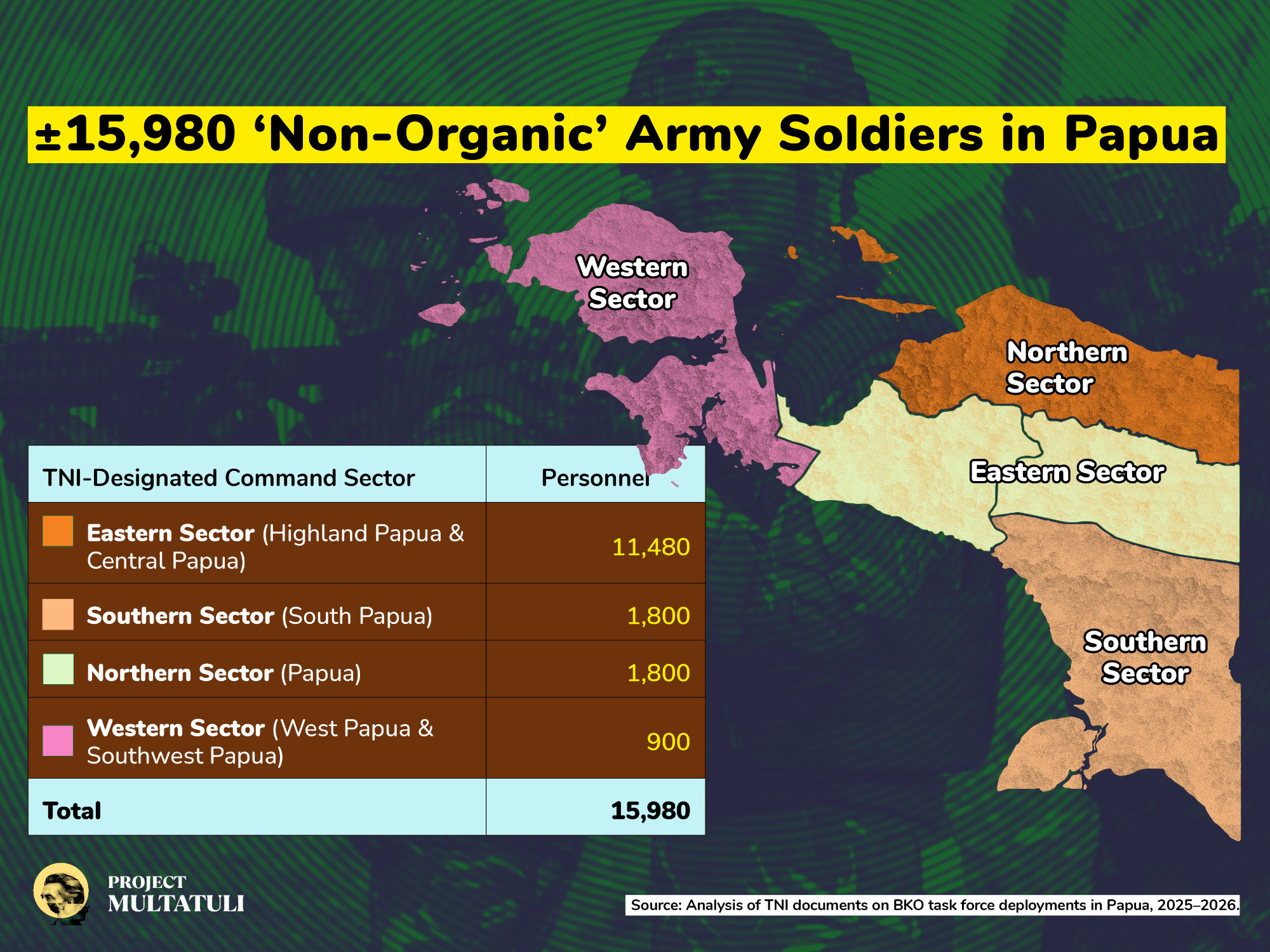
Kodam XVII/Cenderawasih, headquartered in Jayapura, covers Papua’s northern and southern sectors. Kodam XVIII/Kasuari, based in Manokwari, handles the western sector, which also hosts rotational troops from the Navy.
The TNI classifies West Papua and Southwest Papua as the western command sector. Highland Papua and Central Papua fall under the eastern sector.
The TNI Habema Operations Command, established in February 2024 to unify TNI and police operations for “conflict management in Papua”, coordinates several BKO task forces in the eastern sector.
These include the Mobile Task Forces, which are tasked with hunting pro-independence fighters. Comprising nine battalions with a total of 4,050 soldiers, the task forces operate across districts and villages in Highland Papua and Central Papua.
There are also Rajawali Task Forces, which are staffed by two infantry battalions, one unit from the Special Forces Command (Kopassus), and one from the Army Strategic Reserve Command (Kostrad). A Rajawali Task Force has 1,076 soldiers, and the TNI deploys two of them to the eastern sector every year.
The current rotation is being carried out by the Rajawali 4 and Rajawali 5 task forces. The former is deployed from January through October 2026, while the latter is deployed from February through November 2026.
The TNI also fields Raider Task Forces, comprising four battalions with a total of 1,800 soldiers. They are deployed to Puncak and Intan Jaya in Central Papua, as well as upper Nduga and lower Nduga in Highland Papua.
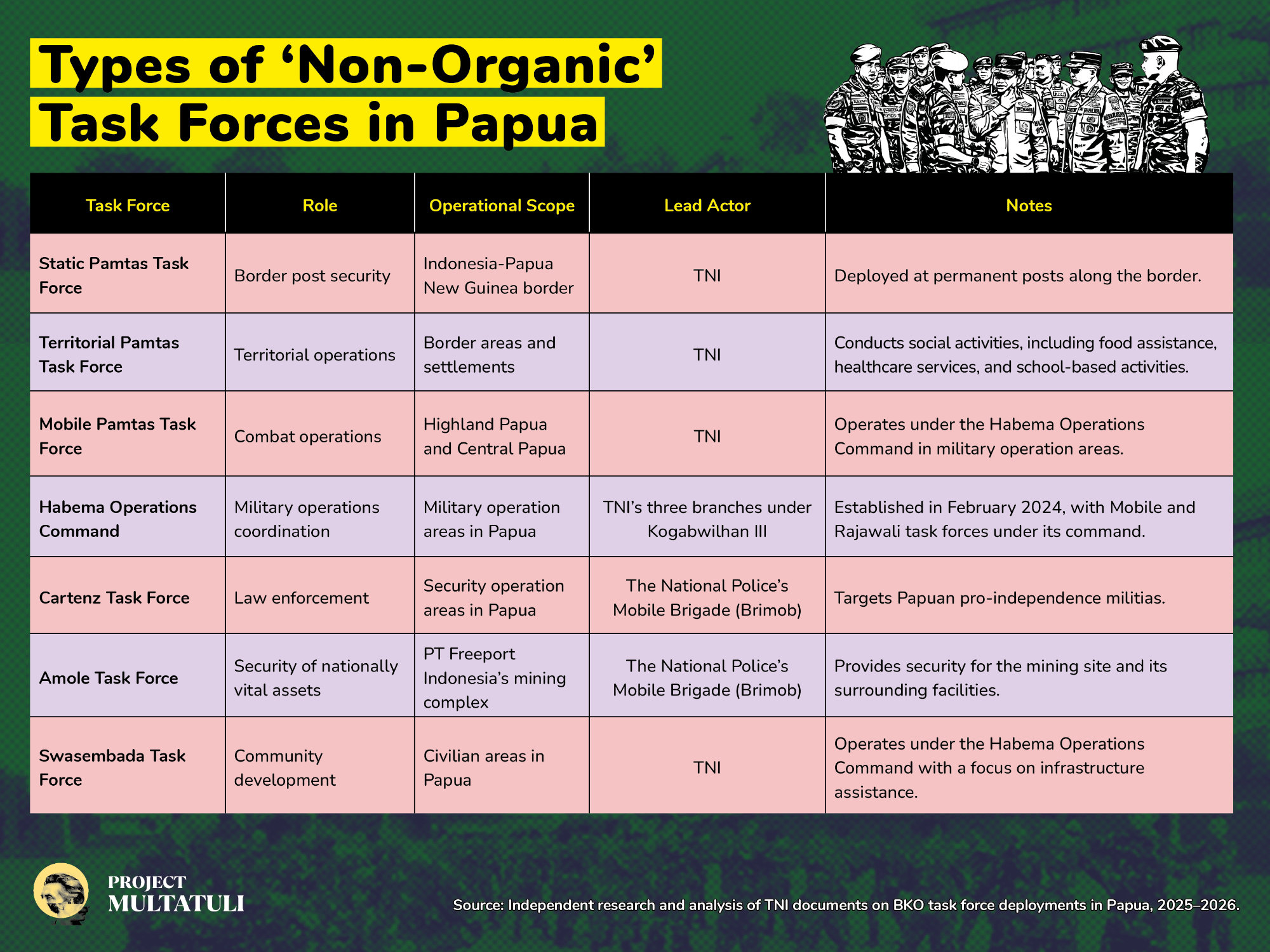
Moreover, the TNI runs joint operations with the National Police (Polri) through the Cartenz and Amole task forces.
The Cartenz Task Force, which authorities describe as a law enforcement task force, regularly pursues individuals suspected of belonging to the West Papua National Liberation Army (TPNPB), the armed wing of the Free Papua Organization (OPM).
Meanwhile, the Amole Task Force guards the PT Freeport Indonesia gold mining complex in Mimika, Central Papua, under its “nationally vital asset” designation.
Across these deployments, the most striking pattern is the concentration of TNI combat forces in the eastern sector.
Some 11,480 rotational Army soldiers are deployed in the eastern sector, accounting for roughly 72% of the Army’s BKO troops in Papua. Nearly 90% of all rotational TNI forces in Papua also come from the Army.
The TNI Habema Operations Command and its task forces fall under the Joint Defense Area Command (Kogabwilhan) III, headquartered in Mimika.
The military formed Kogabwilhan III in September 2019 to integrate the three TNI branches and streamline the chain of command for responding to threats to sovereignty in Papua and Maluku. In effect, this command serves as Papua’s combat coordinator.
Lt. Gen. Lucky Avianto, a Kopassus officer and the top graduate of the 1996 Military Academy class, serves as commander of Kogabwilhan III. He previously commanded Kodam XXIV/Mandala Trikora, based in Merauke, and the TNI Habema Operations Command.
Lucky replaced Lt. Gen. Bambang Trisnohadi, also a Kopassus officer and the top graduate of the 1993 Military Academy class, in March 2026. The change followed Bambang’s appointment as the TNI’s chief of territorial staff (Kaster), a position that President Prabowo Subianto revived 25 years after President Abdurrahman Wahid abolished it.
As the main operational command, Kogabwilhan III reports directly to the TNI commander, who answers to the president as commander in chief. The TNI commander also coordinates with the defense minister on defense policy and administrative support.
This chain reveals how the deployment of thousands of BKO soldiers to Papua is authorized. Every troop rotation, regardless of military branch, requires the TNI commander’s approval and the defense minister’s acknowledgment, with ultimate responsibility resting with the president.
Given the scale, structure, and ways the military operates in Papua, what is happening there cannot adequately be described as a law enforcement operation against armed criminal groups, or KKB, as the Indonesian government has repeatedly characterized it.
More tellingly, at a press conference in Mimika on May 8, 2026, Kogabwilhan III commander Lt. Gen. Lucky explicitly referred to the militia in Papua as the OPM rather than the KKB.
The statement implicitly gave the OPM political recognition and reinforced the view that what is taking place in Papua is a military operation, if not a state of war.
The consequences of this military operation are real: civilians die, members of the security forces and pro-independence fighters are killed, and over a hundred thousand people flee their own villages.
A Lopsided War, Over 122,000 Neglected Refugees
Papua’s central highlands have long been a stronghold of pro-independence militias. The terrain is difficult, with many areas accessible only by small aircraft flying remote routes. Dense vegetation covers much of the region, providing the militias with natural protection during armed conflict.
Administratively, the central highlands fall within Highland Papua and Central Papua. Rotational TNI troops are therefore deployed across nearly all parts of the two provinces. Of their 16 regencies, only Nabire, the capital of Central Papua, does not host “non-organic” forces.
Since October 2024, however, Nabire has served as the new headquarters of Military Resort Command (Korem) 173/Praja Vira Braja under Kodam XVII/Cenderawasih. The Korem headquarters was relocated from Biak to Nabire as part of the military’s expanding presence in Central Papua, a province established only in July 2022.
Intan Jaya is one of the regencies in Papua’s central highlands with the highest concentration of rotational troops. Four task forces comprising 1,800 BKO soldiers are currently deployed there. The soldiers are assigned to Raider and Mobile task forces under the TNI Habema Operations Command.
The TNI identifies Intan Jaya as the base of five pro-independence militia groups with a combined strength of about 300 fighters. Compared with the 1,800 BKO soldiers deployed there, that amounts to a ratio of six soldiers for every militia member.
As of 2025, Intan Jaya’s population stood at 137,340. That works out to roughly one soldier for every 76 residents.
Intan Jaya is also home to the “gold mountain” of Blok Wabu, a former PT Freeport Indonesia exploration site that has since been returned to the Indonesian government.
Located in the mountains of Sugapa District, Blok Wabu is believed to contain one of Indonesia’s largest known gold deposits. Indigenous Papuans have repeatedly opposed plans to turn their ancestral land into a gold mining zone.
From 2025 through May 2026, at least seven armed clashes in Intan Jaya triggered waves of displacement. According to Human Rights Monitor, at least 20,379 people from Intan Jaya are now internally displaced.
One military operation that struck fear among residents took place on Oct. 15, 2025, in Soanggama village, Homeyo District, Intan Jaya.
The ambush involved at least Rajawali, Raider, and Mobile task forces, with “non-organic” soldiers deployed from Maros, Manado, Malang, and Surabaya. The units served under the TNI Habema Operations Command from March 2025 through February 2026.
According to the TNI, Soanggama at the time served as a base for an armed criminal group (KKB) led by Undius Kogoya. The KKB in question was Regional Defense Command (Kodap) VIII of the West Papua National Liberation Army (TPNPB), part of the Free Papua Organization (OPM).
When the combined Habema forces arrived in the morning, the militia reportedly attacked them. In response, the TNI said its soldiers “were forced to take firm and measured action in accordance with combat procedures”.
The military said 14 people had died, all of them OPM members. The Intan Jaya Conflict Mediation Team reached a different conclusion, reporting 15 fatalities.
“The additional victim was a woman who fell from a bridge,” said Yoakim Mujizau, head of the Intan Jaya Conflict Mediation Team.
“A pregnant woman panicked, ran, tried to cross a river, climbed a wooden bridge, slipped, fell, and was swept away by the current. She died.”
Yoakim said his team recovered 11 bodies, only five of which were identified as OPM members. The bodies of four other victims were never found.
He said the TNI gathered villagers and sorted them according to the names on their ID cards and their physical features.
“But we highlanders have almost identical faces, physical features, and haircuts,” Yoakim said.
Soldiers even killed a villager named Agus simply because his surname was Kogoya, even though he was not an OPM member. “The Agus who was an OPM member wasn’t even there,” Yoakim said.
Another victim was a man with a hearing and speech disability. Soldiers targeted him because they considered him suspicious. Villagers knew him as an ordinary civilian who regularly traveled from one village to another.
Contrary to villagers’ accounts of horror in Soanggama, the TNI claimed that its forces had “liberated” the village from “acts of terror and violence” by armed groups, leaving it “safe and conducive”, a stock phrase the Indonesian military uses to describe areas it considers pacified.
The TNI also said the Soanggama operation had not triggered a wave of displacement, claiming that the villagers welcomed the troops and even donated land and facilities for use as a tactical post.
Field reports, however, indicated otherwise. After the operation, 145 residents fled to a neighboring district to escape the armed conflict.
The violence did not stop there. About six months later, in May and June 2026, two grenade explosions struck Agisiga District, also in Intan Jaya.
The first hit the Santo Paulus Nabuni Mbamogo Church compound after Sunday Mass. A later incident involved a drone-dropped grenade that injured a deaf woman, who is now in serious condition at Nabire Regional Hospital.
Intan Jaya is not the only area gripped by fear and trauma. Similar conditions are widespread in Puncak, Nduga, Yahukimo, Lanny Jaya, and Pegunungan Bintang across Highland Papua and Central Papua, as well as in Maybrat, Southwest Papua.
Over the past eight years, armed violence in Papua has displaced more than 122,000 people.
According to a report from the Indonesian Bishops’ Conference (KWI), the Communion of Churches in Indonesia (PGI), and the Papua Church Council, the majority of displaced people were too afraid to return home because of armed conflict and threats from both sides: the pro-independence fighters and Indonesian security forces.
Some refugees reported that their family members had been directly threatened. Many suffered from food shortages and could not access basic health care or education. The report concluded that the displaced urgently needed protection.
The largest group of displaced people comes from Nduga. About 60,000 residents have been unable to return home since 2018. They crowd into displacement camps in Wamena, the capital of Highland Papua.
The largest wave of displacement began after TPNPB’s Kodap III Ndugama, led by Egianus Kogoya, killed at least 19 workers of PT Istaka Karya in Yigi District, Nduga, in early December 2018. PT Istaka Karya was a state-owned contractor working on the Trans-Papua Highway project.
Security forces accused Egianus’ group of being behind several shootings in Nduga since 2017. The same group also held Philip Mark Mehrtens, a New Zealand pilot for Susi Air, hostage from February 2023 through September 2024.
Egianus’ own background is murky. Some sources describe him as the son of Silas Kogoya, an OPM figure involved in the hostage-taking of a Lorentz Expedition team in Mapenduma District, Nduga, from January through May 1996. Security forces killed Silas during the Kopassus hostage rescue operation known as Operation Mapenduma. At that time, Prabowo Subianto commanded Kopassus.
After the PT Istaka Karya incident, Indonesian security forces aggressively swept through areas they believed to be TPNPB strongholds. Starting in Nduga, operations spread to other areas across the central highlands.
The police initially led these operations largely through their Mobile Brigade (Brimob) combat units, with the TNI playing a supporting role. But since the TNI Habema Operations Command was formed in 2024, thousands of rotational soldiers have been deployed to Papua to conduct combat, intelligence, and territorial operations.
According to internal TNI documents, the military is now building joint forward tactical posts within residential areas in the central highlands. The TNI plans nine posts in Nduga, seven in Puncak, six in Intan Jaya, and one in Deiyai.
For the TNI, these posts will strengthen the foundation for counterinsurgency and territorial operations. For Papuan civilians, the same posts mean tighter surveillance over their daily lives.
The high intensity of armed violence has fueled a black market in weapons. A Project Multatuli report in December 2023 revealed the involvement of soldiers and police in illegal arms transactions through multiple layers of intermediaries before the weapons reached pro-independence fighters.
Despite the enormous risks, the lure of profit keeps the illicit trade alive. It operates sporadically across Papua.
For example, we found that a single round of ammunition worth Rp4,000 to Rp10,000 (about 22-55 US cents) can sell for 10 times that price in Papua. A similar markup applies to M4 assault rifles. From a base price of around Rp90 million (around US$4,975), the price can triple by the time the weapon reaches a buyer in Papua. This profit-chasing pattern resembles the illegal gold mining business in Central Papua.
It is no surprise that in amateur videos released by the TPNPB, militia members appear holding modern weapons alongside older and traditional arms. The question is where those modern weapons come from.
Those whom authorities call “armed criminal groups” may be obtaining their weapons from networks that involve the authorities themselves. When firefights break out, both sides may well face each other with the same type of assault rifle.
Another irony emerges when comparing the size of the security forces in Papua with the strength of the pro-independence militia.
The police have estimated the militia’s total strength at around 1,438 fighters. Our research shows that the combined number of soldiers and police in Papua reaches 103,196. That produces a ratio of 72 security officers for every militia member.
With such a lopsided ratio, security concerns alone can’t explain why thousands of rotational soldiers are being sent to Papua.
So, what is the real reason behind this war?
Why does this asymmetric war show no sign of ending? How long will the TNI continue combat operations in Papua? At what point can the Indonesian government claim success for its military operations there? When will the thousands of rotational soldiers be fully withdrawn from Papua? And when will Papuans be able to live peacefully on their own land?
Occupation Disguised as Development
At this point, what is happening in Papua appears to be more than a military operation. It is something larger: an occupation.
The roots of the problem can be traced back to the early 1960s. In 1962, Indonesia and the Netherlands signed the New York Agreement at United Nations headquarters following negotiations mediated by the United States. The following year, Indonesia assumed administrative control of Papua.
The New York Agreement, however, required a plebiscite known as the “Act of Free Choice” to determine whether the Papuan people wanted independence or integration with Indonesia.
The Indonesian government successfully lobbied the UN to hold the vote through consensus rather than by universal suffrage. Arguing that most Papuans were illiterate, authorities allowed only 1,026 handpicked representatives to speak for the entire Papuan population in the 1969 vote, known in Indonesia as Pepera.
Numerous studies have documented how Indonesian intelligence used manipulation, intimidation, and even armed violence against Pepera participants. For this reason, the plebiscite is widely known as “The Act of No Choice”.
Roughly 57 years after that forced integration, Papuans continue to resist, whether through armed insurgency in the villages or peaceful politics in the cities. Throughout that time, the Indonesian government has responded with a repressive security approach.
When Suharto’s military regime, known as the New Order, collapsed amid popular protests in 1998, Papuans celebrated. They traveled to Jakarta and proposed independence through a referendum. The government rejected the proposal.
After returning to Papua, they formed a shadow government, organized elite forces representing highland and coastal communities and Indigenous groups, and built networks of youth groups and civilian militias down to the district level. The Indonesian military quickly crushed that political movement.
Meanwhile, in Jakarta, the reformist government of President Abdurrahman Wahid, widely called Gus Dur, faced destabilization by opportunistic civilian and military elites. The leader of Indonesia’s largest Islamic mass organization was ultimately ousted on July 23, 2001.
On Nov. 10, 2001, Kopassus soldiers killed Theys Eluay, chairman of the Papua Presidium Council and Papua’s most prominent political leader at the time, in Jayapura. He was killed after attending a Heroes’ Day event at the military’s invitation.
The killing marked a rapid contraction of civil and political freedoms for Indigenous Papuans. The space that had briefly opened under Gus Dur closed again after Megawati Soekarnoputri succeeded him. Papua’s window of freedom lasted only a year and a half.
In Papua, instead of offering a political solution, Megawati brought a development agenda through special autonomy in 2001. That policy paved the way for the creation of two new provinces and various new regencies.
More than two decades later, in 2022, President Joko Widodo signed off on the creation of new autonomous regions in Papua. This came in response to the largest wave of protests across Papua, triggered by racist incidents against Papuan students in Surabaya in August 2019. Security forces then aggressively crushed the “Papuan Lives Matter” protest movement.
Once again, the government responded with a development agenda, using administrative fragmentation to suppress Papuans’ political right to self-determination. The process relied on a network of Papuan political and bureaucratic elites whose livelihoods depend on Jakarta.
These elites competed for governor and deputy governor positions, as well as various rent-seeking bureaucratic posts created by the establishment of new provinces in Papua. The arrangement was presented as a simple matter of power sharing. But in the daily lives of Papuans, development programs always come with a security logic.
That logic is visible on the ground. The role of soldiers in Papua extends beyond security and sovereignty, as they have become increasingly involved in a wide range of development projects.
Soldiers, for instance, guard the massive PT Freeport Indonesia mine in Mimika, Central Papua, under its “nationally vital asset” designation, as well as various national strategic projects pushed through during President Jokowi’s tenure. They have also been tasked with clearing forests to advance the government’s food and energy estate project in Merauke, South Papua, which requires three million hectares of land.
Beyond that, soldiers enter civilian spaces: serving as “teachers” in schools, providing mass medical care, distributing food aid, repairing roads, bridges, and irrigation systems, building houses of worship, installing solar panels, and more.
All of this is part of the TNI’s counterinsurgency doctrine. The military expects soldiers to use “smart power” to win over Papuans, including by conducting “territorial development operations” and “social communication”, and by “bringing armed groups back into the embrace of the Motherland”.
These slogans have long been part of the Indonesian military’s approach to war in Papua.
As a result, soldiers in Papua routinely shift roles according to their assignment and context. The TNI Habema Operations Command, for example, not only deploys BKO task forces for combat but also fields Swasembada Task Forces and runs the Papua Pintar (Smart Papua) Program.
When soldiers take on civilian roles, the military presence in Papua appears perpetually necessary. This logic forms the foundation of military occupation.
Step back, and the bigger picture becomes clear. The pattern of Indonesian security operations in Papua forms an occupation system that goes beyond guarding borders and fighting pro-independence militias. It also protects state business interests and carries out territorial tasks to support development programs.
But here’s the irony: this development model, which gives the military an outsized role, hasn’t made Papuans’ lives better or more prosperous.
The budget figures reveal just how skewed the priorities are: the cost of mobilizing and sustaining 17,780 rotational soldiers in Papua alone exceeds the central government transfers received by nearly every province in Papua.
Only two provinces receive more because extractive industries prop them up: Central Papua, home to the giant PT Freeport Indonesia mine, and West Papua, home to the Tangguh LNG project.
When the comparison is narrowed to the regencies most affected by military operations, where many Papuans have become refugees on their own land, only Mimika receives a larger central government transfer than the budget allocated to rotational military operations. Again, this is because Mimika is home to PT Freeport Indonesia’s operations.
***
Ahead of Indonesia’s Independence Day on Aug. 17, 2025, we visited the headquarters of Military District Command (Kodim) 1710/Mimika in Kuala Kencana District. Evening was approaching. Many young soldiers went to worship at the mosque and Catholic church inside the compound. Afterward, they spent their free time at the canteen.
This was their calm before deployment to war zones in the central highlands, such as Intan Jaya, Puncak, Nduga, and Yahukimo. After a year-long assignment, these young soldiers might return home safely. Or they might not. What is certain is that they are sent to sustain the cycle of violence in Papua.
Under the Prabowo Subianto administration’s gunpoint regime, this bloody cycle is not only being preserved but intensified.
Meanwhile, Papua’s more fundamental problems remain unresolved.
Papua’s problem is political. Political problems, anywhere in the world, cannot be resolved through military means. Yet the Indonesian government has never been willing to sit down and negotiate with Papuans, even though it took a different path in dealing with the Free Aceh Movement (GAM), a process that led to the Helsinki Agreement in 2005.
Papuans were not involved when Indonesia and the Netherlands negotiated in New York in 1962. They also had no real choice in the 1969 plebiscite. It is no wonder that the late Papuan intellectual Filep Karma wrote a book titled “As If We Were Half Animals” (2014).
From Suharto’s New Order era to the present, except for a year and a half under Gus Dur, the central government has dictated Papua’s economic development. Yet Papua has consistently ranked lowest among all Indonesian regions on the Human Development Index.
When Papuans voice their discontent, the state responds by sending in troops. Even now, Indonesia is building up a massive military presence there.
In Papua, life is brutally short, while suffering seems endless. The continuing militarization of Papua will only entrench that suffering.*
Notes:
We sent a list of questions about the military approach in Papua to Brig. Gen. Muhammad Nas, head of the TNI Information Center. A staff member responded but did not answer our questions.
We sent the same questions to Lt. Col. Wirya Arthadiguna, spokesperson for the TNI Habema Operations Command, but received no response.
We also sought comment from two members of the House of Representatives’ Commission I but received no substantive answers.
Fahri Salam is editor-in-chief of Project Multatuli.
Made Supriatma is a Visiting Fellow at the ISEAS-Yusof Ishak Institute in Singapore, and an Early Warning Fellow at the Simon-Skjodt Center for the Prevention of Genocide at the United States Holocaust Memorial Museum.
Johanes Hutabarat contributed to this article.
Anne Parisianne translated the original Indonesian piece, and Viriya Singgih edited the English version.